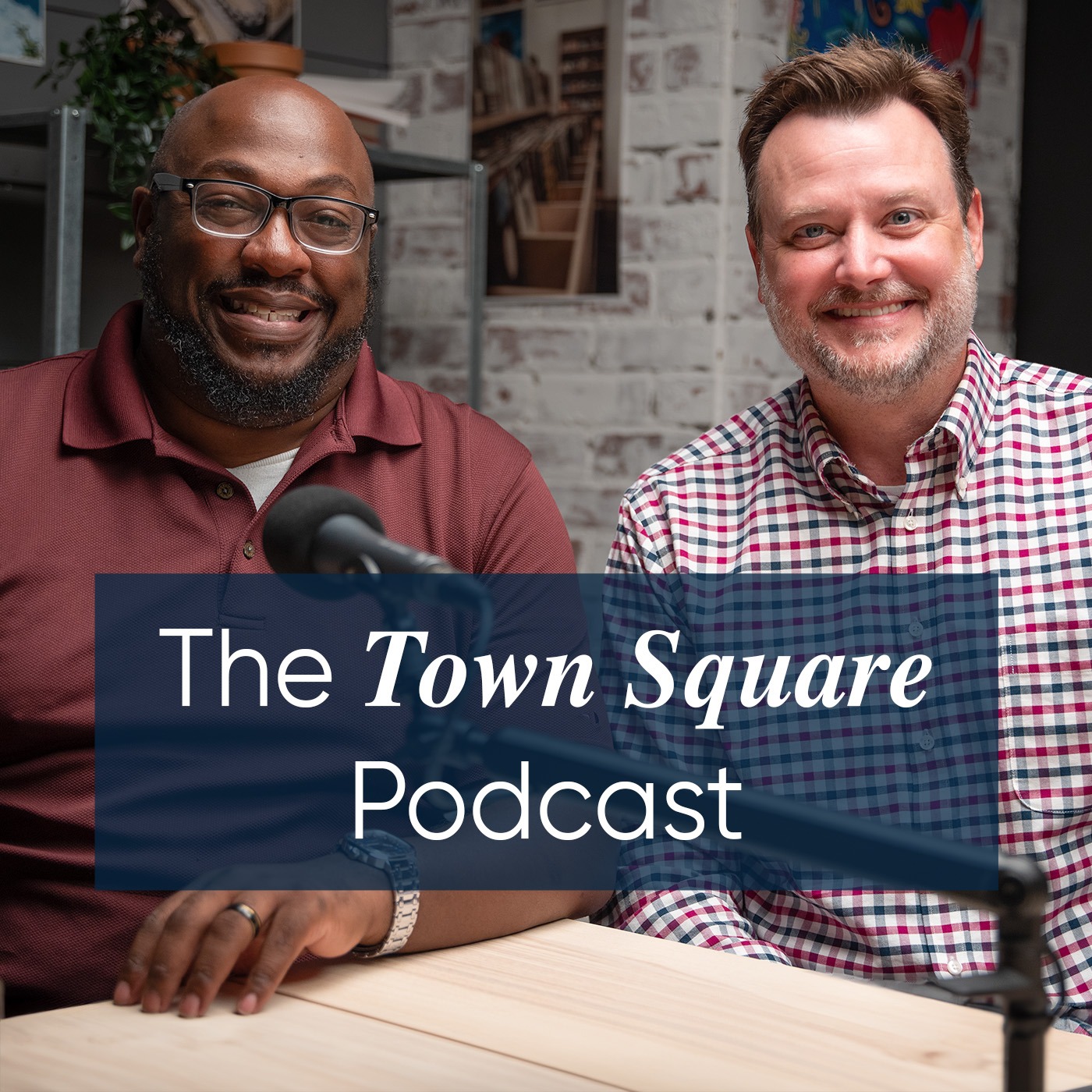
- Jonathan Chavez on Healthcare, Immigration, and Georgia’s 13th District—Episode 104
What does “meeting in the middle” actually mean when the conversation turns to healthcare, immigration, abortion, and the cost of living? It is easy to say we need more cooperation. The harder question is where a candidate is willing to practice it.
In Episode 104, our Candidate Conversation series continues with Jonathan Chavez, a Republican running for US Congress in Georgia’s 13th District. The Conyers resident joins us to discuss the experiences behind his positions, the problems he wants Congress to address, and the places where his answers depart from familiar party talking points.
There is also a surprisingly detailed conversation about loading a dishwasher. Around here, getting to know a candidate includes the person who goes home after the campaign event.
The family and work behind the campaign
Chavez describes a path from Albuquerque to Boston and eventually to Conyers, where his wife’s family helped draw them to Georgia. He talks about raising four children, his family’s decision to homeschool, and the work ethic his father passed down to him.
Those family stories help explain how he approaches opportunity and responsibility. He recalls working as a teenager and learning to keep a goal in view when setbacks came. Today, he says, his children are a central reason he keeps pushing himself.
His professional background brings another perspective. Drawing on his military medical service and work in healthcare administration, Chavez describes leadership as a responsibility to make decisions with the best information available, including information that challenges your first instinct.
Why he wants people who will challenge him
One of the episode’s most revealing stories comes from a military training exercise. Faced with a simulated casualty lying on a grenade, Chavez had to decide how to protect his team while continuing to help other patients. He describes choosing to report the hazard and move the team forward.
The lesson he carried away was about making a decision under pressure, then learning from it. In his civilian work, he says that also means hiring people who will question his approach.
“I need to surround myself with not just yes people,” Chavez says. He wants respectful opposition because someone else may see the angle he missed. That idea becomes a recurring test throughout the conversation: how would it translate from a hospital team to Congress?
Healthcare beyond a yes or no on Obamacare
Healthcare produces some of the most detailed policy discussion. Chavez says he values the Affordable Care Act’s protections for people with preexisting conditions and wants to improve the system rather than reject it wholesale.
He proposes expanding public coverage for certain expensive medical conditions while giving health insurers more ability to compete across state lines, with a minimum coverage standard. In his view, taking on some of the costliest care could create room to press insurers for lower premiums. Those are his proposed changes and expected benefits, not established outcomes.
Chavez connects his ideas to the patients he encounters through his work, including people who struggle to afford copayments. He also describes efforts to shorten inpatient MRI turnaround times and develop cardiac imaging services. For him, the policy question starts with whether people can actually get the care they need.
The discussion leaves room for the implementation questions: how coverage would be financed, how quality would be protected, and what would make the promised savings reach patients. It gives listeners a clearer picture of what he wants to pursue.
Affordability and a different way to collect taxes
On affordability, Chavez discusses housing tax credits, business regulation, and support for small businesses. The hosts press him on the boundary between what Congress can change and what belongs to state or local government.
He also explains his interest in the FairTax proposal, a national consumption tax approach with a monthly household “prebate.” He sees potential in changing how federal taxes are collected, while saying the idea needs more research and questioning whether it would really eliminate the IRS.
For listeners, the useful question is what such a change would mean for a household’s full budget: take-home pay, purchases, and the monthly prebate together. Chavez’s expectations about prices and savings are part of his case for studying the proposal.
Border security and a pathway for longtime residents
Asked what securing the border means to him, Chavez argues for enforcement alongside a more workable legal immigration system. He also says some longtime undocumented residents who have contributed to their communities should have a pathway toward citizenship.
His grandfather’s immigration story helps shape that view. Chavez says this is one area where he differs from some people in his own party, and he describes wanting a process that is faster and better able to vet applicants.
The exchange gets at an important part of Candidate Conversations: a broad campaign phrase can hold very different ideas. Asking the next question is how listeners find out what a candidate actually means.
Schools and measuring student growth
Education brings the conversation back to the relationship between federal support and local decisions. Chavez favors expanding support for students facing poverty, educator development, and students from immigrant backgrounds while giving states and districts room to determine how resources are used.
He argues for measuring students’ progress from their starting points. When students struggle, he wants schools to receive help and resources to improve. He also supports assistance for homeschooling families, while acknowledging that homeschooling is not a workable option for everyone and that public schools will continue to serve families.
Faith, abortion and the limits of party labels
Chavez is direct about his Christian faith and opposition to abortion. He describes those convictions as central to his reasons for running, and he discusses wanting a larger place for prayer and Christian principles in public life.
The hosts also explore how voters weigh competing priorities. A person’s party affiliation does not necessarily tell you what they believe about every issue, or which concern will carry the most weight in their vote. That exchange adds context without resolving the disagreements.
Chavez says he once identified as a Democrat, and he credits conversations with his wife with challenging his views. His willingness to describe that change sits alongside firm positions that some listeners will share and others will question. Both are part of understanding the candidate.
Hear the reasoning and bring your questions
Near the end, the conversation returns to accountability: what should voters expect from the person they send to Washington, and how should they judge the results? Chavez argues for a change in representation and says he does not want a lifelong career in Congress.
This episode offers listeners time to hear his reasoning across several issues, including where he draws a firm line and where he sees room to work with others. Watch the full conversation, consider the proposals, and bring your own questions. That is the work of the messy middle.
Watch Episode 104: https://youtu.be/4b3pWEq1Cv8
Links Mentioned
Jonathan Chavez campaign website - https://jonathanchavezforcongress.com/
FairTax proposal discussed in the episode - https://fairtax.org/about/how-fairtax-works
Watch Episode 104 - https://youtu.be/4b3pWEq1Cv8
Become a Town Square Insider. Don't miss a single episode or the weekly blog posts. Click the link and enter your email address to be a Town Square Insider - https://TheTownSquarePodcast.com/insiders
Sponsors and Advertisers
Thank you to United Bank Mortgage for supporting Town Square Podcast and our Candidate Conversation series. United Bank offers mortgage services with local lenders who can help you explore buying or refinancing a home. Visit https://www.accessunited.com to learn more and connect with their team. Member FDIC. Equal Housing Lender.
1h 10m - Sep 29, 2026 - Zayvion Sheppard on For Atlanta. By Atlanta., Mentorship and Community Giving — E103
What Ten Dollars a Month Can Do for Your Community
YouTube: https://youtu.be/zaKh0YOmQYM
Ten dollars a month may not sound like the beginning of a community investment strategy. Zayvion Sheppard thinks it is a perfectly good place to start. Get 50 people to commit, and those small gifts add up to $500 a month, or $6,000 over a full year. For a grassroots organization helping students prepare for college or neighbors find work, that can mean something practical.
Zay returns to The Town Square Podcast with an invitation to participate in that kind of giving through For Atlanta. By Atlanta., known as FABA. He also brings a book announcement, an honest account of nearly giving up on the organization, and a reminder that the people who invest in a young person may never see the full reach of what they started.
Making room for everyday donors
Zay describes attending an Atlanta benefit and leaving energized by the generosity in the room. He appreciated what large donors and corporate partners could make possible. He also wondered how more people could experience the same connection to the work without a high price of admission.
That question helped shape what he calls “affordable impact.” The FABA 50 invites 50 people to give $10 a month. It is a way to make regular community giving accessible to people who want to help but may never write a large check.
In the conversation, Zay is candid about how hard it can be to ask. At 22, he has had to challenge his own doubts about whether people will trust him with their money. The response from his network has pushed him to take that trust seriously and to stop assuming the answer will be no.
Raise invest and elevate
FABA’s approach centers on raising money, investing in community organizations, and sharing the stories of what those investments make possible. Zay wants donors to see the people and work behind a contribution.
He points to the Taylor Made Foundation as an example. In his account, FABA’s support helped the organization send five graduating students off to college with dorm-room supplies. Refrigerators, microwaves, toiletries and school supplies may not sound glamorous. For a family getting a student ready to leave home, they are real needs.
Zay also discusses support for after-school learning and workforce development. When asked whether education, housing and employment define the organization’s limits, he clarifies that fighting poverty is the broader purpose. The team wants to find trusted organizations doing effective work, including those that may not fit neatly into a predetermined category.
Finding the people a neighborhood already trusts
The way Zay describes finding partners is refreshingly local. Talk to people. Ask who has helped their children, their families or their neighbors. Pay attention to the organization that keeps showing up, even if its leader is too busy doing the work to promote it.
He wants that community knowledge to matter in funding decisions. Many of the leaders he describes hold another job while running their nonprofits. FABA aims to support their work without adding a heavy administrative burden. Follow-up conversations still matter: What did the support accomplish? What need remains? What could additional funding make possible?
That approach also puts responsibility on FABA. Zay describes board oversight and regular conversations about the organization’s decisions. He tells a particularly personal story about a donor who preferred to hand over cash: a $20 contribution covering two months of support. He does not know what it took for her to spare that money. He knows he has a responsibility to use it well.
The part of leadership people rarely announce
Zay admits that there was a point when he hoped FABA might quietly fade away. The ambition was big, and the team had overcommitted. Then someone at a professional program asked about the organization after Zay had deliberately left it out of his introduction.
That conversation helped him reconsider. Instead of trying to do everything, the team focused on work it knew it could carry out: raise funds, support organizations already serving their communities, and tell their stories. Starting with a small group of partners gave them room to learn how to manage an investment cycle responsibly.
It is a useful part of the story for anyone who has started something and then wondered whether they were qualified to keep going. Zay’s confidence has grown alongside that willingness to narrow the work, ask questions and accept help.
A book about the people who invested in him
Zay also shares that he has completed a manuscript. Its working title is A Dollar’s Worth of Impact, a callback to a story he told during his earlier Town Square appearance. The title and publication plans are still developing.
He hopes the book will speak to young people trying to lead and to the adults mentoring them. Writing it has meant revisiting family support, the loss of his grandfather, and the people who made room for him in places he had never been before.
The central idea is personal. Zay does not describe his path as proof that he was smarter than everyone around him. He points to the time, attention and opportunities other people gave him. He wants readers to consider what a similar investment might mean for someone else.
Taking Newton County with him
The conversation keeps returning to home. Zay talks about his work in government and community affairs at Georgia State University and the relationships he has built in Atlanta. He also makes clear that success elsewhere does not erase his connection to Newton County.
“I like home,” he says.
He connects that attachment to a question he uses to think about community decisions: “And how are the children?” For Zay, the value of an investment may become clearest years later, when a student who received support has the chance to help someone else.
His invitation is practical. Give if you can. Share the work. Introduce FABA to an organization your community trusts. There are several ways to participate, and the first one may be as simple as starting a conversation.
Watch the full conversation with Zayvion Sheppard:
Links Mentioned
For Atlanta. By Atlanta. https://foratlbyatl.org/
The FABA 50. https://foratlbyatl.org/the-faba-50/
Taylor Made Foundation https://taylormadefoundation.org/
East Atlanta Kids Club https://eastatlantakids.org/
The Same House https://www.thesamehouse.org/
Newton Education Foundation https://newtoneducationfoundation.org/
Sponsors and Advertisers
United Bank
United Bank serves individuals, families and businesses with banking and lending services. Thank you to United Bank for supporting conversations that keep our community connected. Visit the Covington office or explore what the bank offers online.
56m - Sep 22, 2026 - Rev. Dr. Terrence Evans on St. Paul AME Church and Faith in Community—Episode 102
History Is in the Spirit: Rev. Dr. Terrence Evans on Faith Memory and Civic Life
Town Square Podcast Episode 102 | Faith and Community
Watch the conversation on YouTube: https://youtu.be/73cI1WtGUGg
A church can hold a community’s history in ways that a courthouse file or a history book cannot. St. Paul African Methodist Episcopal Church has served Covington since 1878. Its congregation rebuilt after fires, lived through segregation and integration, helped people register to vote, and carried its ministry from Stone Mountain Street to a larger home on Brown Bridge Road.
In Episode 102 of the Town Square Podcast, Rev. Dr. Terrence Evans joins the Faith and Community series to talk about the life behind that history. His story moves from Opa-locka and Miami to Georgia State basketball, eighteen years serving people experiencing homelessness, a call to ministry, and his 2023 appointment as senior pastor of St. Paul AME Church in Covington.
The conversation also offers a plain-language introduction to the AME tradition: why the denomination was formed, how its structure works, and why worship, memory, social action, and grace remain connected.
The Barbershop Test
Before Evans was a pastor, he was Sherry and Willie’s son, a six-foot-seven basketball player from Opa-locka, Florida, and a young man deciding where a scholarship might take him. He knew Miami. Atlanta was new.
Georgia State began to feel like home almost immediately. Evans arrived without having gotten a haircut, asked his coach for help, and was taken straight to a local barbershop. That ordinary act told him something important: he could find community here.
His years as a Panther also shaped his approach to leadership. Evans remembers one coach as quick and direct and another as deeply relational. The second model is especially visible in his ministry now. He believes leaders should offer clear direction, trust people to use their gifts, receive feedback, and pivot when a better path serves the church and the gospel.
Grace in Action at Jefferson Place
After earning a criminal justice degree with a minor in sociology, Evans considered law enforcement. His mother, a Miami police officer, urged him to remain in Atlanta. A summer youth-employment job opened the door to Fulton County government, and an overnight position at Jefferson Place became an eighteen-year vocation.
Jefferson Place was a transitional housing program located in the former Fulton County jail. Evans began by checking residents in at night and later became a case manager. He watched men complete technical training, build businesses, restore family relationships, and move toward stability. He also witnessed relapse, disappointment, and the painful consequences of rules that could not simply be wished away.
That work changed his understanding of ministry before he had a pulpit. “It helped me to see grace in action,” Evans says. “It helped me to see how it is that there are consequences.” Holding those truths together became part of his pastoral formation: compassion does not erase accountability, and accountability does not cancel a person’s humanity.
A Call and an Immediate Assignment
Evans was raised Baptist and did not grow up expecting to enter ordained ministry. While serving at Jefferson Place, raising three children with his wife, and worshiping in an AME congregation, he began to recognize a persistent call. He entered the AME Board of Examiners process and studied at Turner Theological Seminary at the Interdenominational Theological Center.
The transition from preparation to pastoral responsibility came quickly. In 2010, almost immediately after his ordination as an itinerant deacon, a presiding elder told him about a small church that needed a pastor. His first appointment was St. Paul AME Church in Dallas, Georgia. He later served Greater Ward Chapel AME Church in Columbus before being appointed to St. Paul in Covington in June 2023.
There is a fitting symmetry in beginning and continuing his pastoral work at congregations named St. Paul. There is also a consistent thread: Evans’ ministry grew from service, relationships, and the belief that God was already present in places he had not expected to go.
What African Methodist Episcopal Means
For listeners who have seen the initials without knowing the distinctions, Evans breaks the name into three parts. African points to a church founded by people of African descent. Methodist identifies its Wesleyan theological roots and disciplined approach to Christian life. Episcopal describes a structure of governance led by bishops, with pastors appointed to congregations and layers of accountability that extend from the local church to the denomination’s General Conference.
Evans describes a connectional church rather than a collection of independent congregations. St. Paul belongs to the East District of the Atlanta North Georgia Annual Conference, within the Sixth Episcopal District. Local church conferences, quarterly conferences, district and annual conferences, and the denomination’s quadrennial General Conference each have a role.
The structure can sound complicated from the outside. Evans sees strength in its checks, relationships, shared doctrine, and wider mission. The local congregation is rooted in Covington, but it belongs to an international church.
A Church Born from Worship and Protest
The AME story begins with the Free African Society, organized in Philadelphia in 1787 by Richard Allen, Absalom Jones, and others. After Black worshipers at St. George’s Methodist Episcopal Church faced racial discrimination, Allen and others pursued a place where people of African descent could worship freely and serve one another fully. Allen established Bethel in 1794, and in 1816 representatives of Black Methodist congregations formed the African Methodist Episcopal Church.
Evans emphasizes that this history is not only denominational history. It is American history. The church grew from a refusal to accept dehumanization inside Christian worship and from a commitment to mutual aid, religious autonomy, and the full dignity of Black people.
That founding story still asks something of the church. Evans argues that remembering injustice is not an exercise in resentment. It is a way to understand the cost of progress, honor those who endured and resisted, and recover the church’s responsibility to serve people whose dignity is still challenged.
St. Paul Carries Its History Forward
St. Paul’s own story reflects that resilience. Founded in Covington in 1878, the congregation rebuilt after multiple fires and continued serving across generations. Its history includes voter registration and civil rights work, and that legacy now lives through its Social Action Ministry.
The congregation hosts a polling place, organized a candidate forum, and works with community partners to help new voters understand the political process and identify the offices and people on their ballots. Evans is careful about the distinction: this is nonpartisan participation, not an instruction about whom to support.
The point is access and responsibility. Local elections can be decided by a handful of votes, while many residents do not know who represents them or how local offices affect daily life. For St. Paul, encouraging informed participation is connected to the sacrifices of people who fought for voting rights.
When the congregation moved from its historic site to Brown Bridge Road, some members worried about leaving physical history behind. Evans offers a line that captures the transition: “History is not in the walls. History is in the spirit.” A larger campus did not discard the story. It gave that story more room to continue.
What a Sunday at St. Paul Feels Like
Evans describes St. Paul as a congregation where a visitor should feel like family. The service follows a recognizable AME order that includes the doxology, prayer, Scripture, music, and preaching. First Sundays lean more traditional, with hymns that carry theology and memory across generations. Contemporary music has a place too.
Evans calls himself a teacher and storyteller more than a “whooper,” though he acknowledges that the energy can rise. He often works from the lectionary and has also begun preaching in series. Preparation matters, but so does listening. He describes preaching as a collective moment shaped not only by the person in the pulpit but by the congregation’s response, silence, faces, and later conversations.
Sunday school begins at 9:30 a.m., and worship begins at 11 a.m., as stated in the episode. St. Paul AME Church is located at 13108 Brown Bridge Road in Covington. Visitors can learn more at https://www.stpaulamecov.org.
A God Who Is Available
Asked what he would say if all of Newton County and the surrounding community were listening, Evans returns to grace: “We have a God that is available.” He means available in success and disappointment, trauma and healing, clarity and uncertainty.
His own path gives the statement weight. The young athlete did not know he would become a pastor. The county employee did not know that overnight work in a transitional housing program would become ministry. The newly ordained deacon did not know a pastoral appointment was waiting before he left the building.
Faith, in Evans’ telling, is not an escape from community life. It is a reason to enter it with humility, memory, service, and hope. St. Paul’s history belongs to Covington, but its work is happening now, in worship, voter education, hospitality, and the ordinary relationships through which a community learns to see one another more fully.
Links Mentioned
Watch Episode 102 on YouTube: https://youtu.be/73cI1WtGUGg
St. Paul AME Church in Covington: https://www.stpaulamecov.org
St. Paul AME Church history and pastor biography: https://www.stpaulamecov.org/about-us
African Methodist Episcopal Church history: https://www.ame-church.com/our-church/our-history/
Luther Rice College and Seminary: https://www.lutherrice.edu
Bizzy Bee Exterminators: https://www.bizzybeeexterminators.com
Sponsors and Advertisers
Luther Rice College and Seminary
Luther Rice offers biblically grounded, accredited, 100 percent online programs for traditional students, adult learners, ministry leaders, and working professionals. Explore undergraduate, graduate, certificate, and doctoral options at https://www.lutherrice.edu.
Bizzy Bee Exterminators
Bizzy Bee Exterminators is a full-service pest-control company serving homes and businesses in Covington and beyond. Request service at https://www.bizzybeeexterminators.com or call 770-787-3718.
1h 2m - Sep 15, 2026 - Rep. Clint Crowe on Affordability Housing and Data Centers | Candidate Conversations — Episode 101
The Cost of Staying Home: Clint Crowe on Property Taxes Housing and Data Centers
Watch the conversation on YouTube: https://youtu.be/XjBIapdxdqI
For many homeowners, affordability is no longer an abstract campaign issue. It is the tax bill on a house they have owned for decades, the price of a starter home their children cannot afford, and the argument over whether new development will ease the pressure or create new costs.
Representative Clint Crowe brings several perspectives to that conversation. He represents Georgia House District 118, chairs the House Public Safety and Homeland Security Committee, serves on Ways and Means and four other committees, and has worked in law enforcement and real estate. In Episode 101 of the Town Square Podcast, he explains how those experiences shape his approach to taxes, housing, data centers, and the work of representing a district that includes parts of Newton, Butts, and Monroe counties.
This Candidate Conversations episode presents Crowe’s record and positions in his own words as voters prepare for the November election.
A Career Built Across Public Safety and Real Estate
Crowe was first elected in 2020 and took office in 2021. Before entering the legislature, he volunteered with a fire department, worked as a 911 dispatcher, served in law enforcement, and built a real estate company with his family. He describes those jobs as different versions of the same work: dealing with people, solving problems, and trying to find an outcome that competing sides can accept.
His family story also informs the way he talks about public service. Crowe and his wife, Kristie, raised two sons and later adopted a great-niece and great-nephew who came to live with them as very young children. He says his decisions at the Capitol affect his own children and grandchildren along with the rest of the district.
Why Legislation Moves Slowly
Crowe offers a practical explanation of a process that often looks needlessly slow from the outside. A House bill may pass through subcommittee hearings, a full committee vote, the Rules Committee, and the House floor before beginning a similar path in the Senate. Tax referendums and some other measures require a two-thirds House vote rather than a simple majority.
He argues that the friction is intentional because state policy must work across communities that differ sharply in population, tax base, and public-service needs. Crowe says committee hearings are among his favorite parts of the job because local officials and residents can explain how a proposal would affect them before lawmakers vote.
The Property Tax Question
The longest policy discussion begins with residents who fear being priced out of homes they already own. Crowe says he has heard from seniors on fixed incomes who cannot keep up with rising property-tax bills. His guiding view is that a primary residence should eventually become secure from that pressure. In his words, a homeowner should not have to “continuously rent that from the government for your entire life.”
Crowe discusses House Bills 581 and 92, including the effort to limit increases in taxable value through a floating homestead exemption. He also describes a proposal that did not pass in the most recent session: replacing property taxes on homesteaded homes with revenue from an additional one-cent sales tax and other funding sources.
He acknowledges the central tradeoff. Local governments and school systems depend on property-tax revenue, and a sales tax spreads costs to renters and consumers as well as homeowners. Crowe argues that visitors would pay part of the sales tax, while communities with weaker retail activity would need another way to replace lost revenue. The episode does not pretend that the arithmetic is simple.
Housing Costs Begin Before Construction
Crowe also connects affordability to the shortage of homes within reach of first-time buyers and public-safety employees. Drawing on his real estate background, he says permitting delays, minimum square-footage rules, low-density requirements, infrastructure costs, and limited housing supply all raise the final price paid by a buyer.
He supports local planning and zoning, but questions rules that prevent smaller or less expensive homes even when they meet accepted safety standards. His concern is that every delay and development cost eventually appears in the home’s sale price. The policy tension is familiar: communities want control over growth, while the same restrictions can narrow the supply of attainable housing.
Data Centers and Local Control
The conversation then moves into one of Newton County’s most contentious subjects. Crowe opposes broad moratoriums on data centers and believes local comprehensive plans should determine where major industrial uses belong. He points to Stanton Springs as an example of placing a data center inside an established technology and industrial area rather than near homes.
Crowe frames data centers as infrastructure tied to artificial intelligence, economic competition, and national security. He also recognizes the concerns that residents raise about electricity, water, noise, tax incentives, and the number of permanent jobs. He argues that large users should pay for the infrastructure their projects require and that local governments must use new revenue in ways that benefit their residents.
Several statements in this part of the interview, including Crowe’s claims about foreign misinformation and water-use patterns, are his assessments as presented in the episode. His broader position is clear: he favors case-by-case local decisions, careful siting, and financial safeguards rather than a statewide stop.
Showing Up as the Measure of Representation
When asked why voters should return him to office, Crowe emphasizes responsiveness. He recounts a conversation with a Democrat who disagreed with him on several issues but voted for him because, as the voter put it, “I know you show up.” Crowe says he wants residents to judge him by his positions and his accessibility rather than by the party label alone.
That answer fits the larger conversation. Crowe does not claim that every policy problem has an easy fix. He argues instead that experience, access, and a willingness to explain a vote matter when the issues involve competing taxpayers, local governments, schools, businesses, and neighborhoods.
Episode 101 gives District 118 voters a sustained look at how Crowe reaches those judgments. The purpose of Candidate Conversations is to let voters hear that reasoning directly and decide how well it matches their own priorities.
Links Mentioned
Watch Episode 101 on YouTube: https://youtu.be/XjBIapdxdqI
Georgia General Assembly member directory: https://www.legis.ga.gov/members/house/5002
Crowe for Georgia: https://croweforgeorgia.com/
Georgia General Assembly legislation search: https://www.legis.ga.gov/legislation/all
Sponsor
United Bank Mortgage
United Bank Mortgage offers conventional, jumbo, government-backed, first-time homebuyer, and Community First mortgage options. Its local lenders help borrowers understand available programs and move from application through closing. Learn more at https://www.accessunited.com/mortgage/mortgage-services or visit a United Bank office.
United Bank. Member FDIC. Equal Housing Lender. NMLS number 413054.
1h 14m - Sep 8, 2026 - Kamal Carter of A Long Talk on Constructive Conversations and the CPR Method — Episode 100
Episode 100: From Furious to Curious with Kamal Carter of A Long Talk
One hundred episodes ago, The Town Square Podcast began with a simple conviction: people who see the world differently should still be able to sit together, ask honest questions and search for understanding. We call it “unity, not uniformity.” For our 100th episode, we found a guest whose life’s work feels almost tailor-made for that mission.
Kamal Carter is the president and co-creator of A Long Talk About the Uncomfortable Truth, an organization that helps people interrupt ignorance and bigotry in real time. Its work reaches locker rooms, boardrooms, schools, churches and other places where people with different histories and perspectives must learn to function as a team.
That made Carter more than a fitting guest for this milestone. It made him the perfect one.
Two Dads Who Wanted Something Better
A Long Talk did not begin as a polished national initiative. It began during the pandemic with Carter and his business partner, Kyle Williams—two former educators and two fathers who wanted a safer, more humane world for their children.
Carter traces his instinct for service even further back. One of his grandfathers was a Tuskegee Airman who modeled excellence, discipline and responsibility while also carrying the pain of being treated as less than after serving his country. That family history taught Carter that achievement should be joined to service and that each of us can choose to leave the world better than we found it.
The immediate spark for A Long Talk came after one of Williams’ sons attended a protest in Washington, D.C. An accusatory exchange with a college basketball teammate escalated through text messages and FaceTime. Williams contacted the coach, expecting to talk the next day. Instead, the coach called that night—and listened.
That conversation changed the temperature. The coach asked for resources, began taking action on his campus and helped prove that a difficult exchange did not have to end in injury or estrangement. Within six weeks, Carter and Williams were helping convene a conversation with 107 college basketball coaches. What started with one father, one coach and one hurting student began spreading across athletics, education and corporate life.
Information + Empathy = Action
Carter describes the A Long Talk formula plainly: “information plus empathy equals action.” The goal is not to drag everyone to the same opinion. It is to create an environment where people can speak honestly, listen carefully and respond to harmful statements without either freezing or exploding.
That distinction matters. A conversation leaves room for questions, reflection and boundaries. A confrontation becomes a contest to win. Carter argues that people retain the right to their beliefs, but organizations also have the right—and responsibility—to establish what conduct belongs in their locker room, workplace, church or civic space.
The work begins with grace and what Carter calls “progress over perfection.” If people fear that one awkward phrase will get them banished, honest conversation becomes nearly impossible. But grace is not passivity. A Long Talk trains people to step in when language is harmful and to replace an instinctive blast of anger with disciplined curiosity.
Go From Furious to Curious
When an inflammatory statement lands, most people do one of two things: freeze or react at full force. Carter offers another option—go from furious to curious. That does not require pretending the statement was harmless. It means regulating the first reaction long enough to understand what was said, why it was said and whether the speaker has ever seriously examined it.
Curiosity can also change who carries the burden of responding. If a sexist comment is made in a room where only one woman holds leadership, why should everyone look to her to challenge it? A colleague can intervene. A teammate can ask the question. A bystander can become an active participant in protecting the culture.
Carter calls critical thinking “kryptonite to ignorance.” It forces a careless generalization into the light, where the person who made it must explain, reconsider or openly own it.
CPR for a Difficult Conversation
The practical tool A Long Talk teaches is CPR: clarify, probe and redirect.
Clarify begins with a deceptively simple question: “What do you mean when you say…?” The key is to repeat the person’s actual words and then remain quiet. Rather than supplying the accusation and the verdict, the listener gives the speaker room—and responsibility—to explain.
Probe moves deeper. A question such as “How do you think that would make your mother, sister or teammate feel?” invites the person to consider impact, not merely intent. Redirect then asks what language or action would support the people affected and the values the group claims to share.
Like any skill, CPR requires practice. Carter tells participants to expect mistakes, extend grace and build new conversational muscle memory through repetition.
We Put CPR to the Test
This episode does more than describe the method. Carter coaches Trey and Gabriel through a hypothetical claim that “everybody in Newton County is racist.” By returning the exact words, asking questions and testing the sweeping logic against real relationships, the exercise demonstrates how curiosity can expose the weakness in a generalization without dismissing the pain that may sit underneath it.
It is uncomfortable work. That is the point. Carter reminds us that the aim is not perfection on the first try; it is becoming ready to respond well when the real moment arrives.
Why This Conversation Belongs in Episode 100
For 100 episodes, The Town Square Podcast has tried to make room for the messy middle: a place where disagreement does not require dehumanization and unity does not require uniformity. A Long Talk is pursuing that same hope through training, role-play and a growing community of people prepared to interrupt harm.
Carter says it may take only one or two brave people in a room to begin changing its culture. That is both a challenge and an encouragement. We do not have to wait for a president, a movement or a massive national campaign. We can begin at a dinner table, in a team meeting, at church, on a school board—or behind a podcast microphone.
One hundred episodes in, that still sounds like work worth doing.
Links Mentioned
Watch Episode 100 on YouTube: https://youtu.be/XjBIapdxdqI
A Long Talk: https://alongtalk.com
A Long Talk resources and CPR Protocol Study Guide: https://alongtalk.com/resources
A Long Talk on social media: https://www.instagram.com/alongtalk2020/ — @alongtalk2020
United Bank Wealth Management: https://www.accessunited.com/wealth-management
Meet Angel Pitts: https://www.accessunited.com/wealth-management/meet-your-team
Sponsor
Angel Pitts — United Bank Wealth Management Advisor
Angel Pitts serves clients in the Covington and Madison markets, helping individuals and families develop wealth-management plans around short- and long-term financial goals. To learn more, call 770-412-4932 or visit https://www.accessunited.com/wealth-management.
United Bank Wealth Management Services: building relationships that go beyond investments.
Disclosure: Wealth Management Services are not FDIC insured, not bank guaranteed, may lose value, are not a bank deposit, and are not insured by any federal government agency.
56m - Sep 1, 2026 - Pastor Justin Adams of NEW LIFE Praise Center | Faith & Community—Episode 99
A church can add square footage without building community. It can fill seats without helping people feel seen. And it can say “everyone’s welcome” without ever proving it at the door.
Pastor Justin Adams believes the proof comes in what happens after people arrive.
In Episode 99 of the Town Square Podcast, Trey Bailey and Gabriel Stovall welcome Adams back for a candid conversation about the growth of NEW LIFE Praise Center, his own recovery story, the church’s non-denominational identity and a ministry philosophy rooted in a simple promise: “Everyone’s welcome—and we mean it.”
A Foyer Built for More Than Foot Traffic
When Adams sums up the past few years at NEW LIFE, he uses one word: growth. The church began the year with “expansion” as a theme, then watched it become something tangible. A new 3,200-square-foot, glass-walled foyer—built with help from local contractors who donated time and materials—gave the congregation a place to gather before and after services.
The addition matters to Adams because the life of a church is not confined to the service itself. He describes families lingering, conversations continuing and a room full of noise and laughter. In church language, it is fellowship. In everyday language, it is people who genuinely want to be together.
The Testimony Behind the Welcome
Adams has lived in Covington for nearly 30 years, but his path to ministry was not tidy. He speaks openly about addiction in his late teens and twenties, a marriage in danger of falling apart and attempts at jail, rehabilitation, therapy and counseling that did not produce lasting change. Then, nearly 20 years ago, he accepted an invitation to church.
He says one encounter with Jesus changed the direction of his life. He has remained sober since, and that experience shapes the way he talks to people who wonder whether their own story is too broken to be redeemed: “If he’d done it for me, he can do it for you.”
That transparency is not a side note to Adams’s ministry. It is central to it. His testimony gives him a common language with people facing addiction, anger, depression, family strain or shame. The point is not to compare wounds. It is to show that grace is not an abstract doctrine—it can meet a person in real life.
Rooted in Scripture, Open About the Questions
NEW LIFE Praise Center is non-denominational, which Adams explains plainly: the church is not affiliated with a larger denominational organization. Its teaching centers on Scripture, Jesus Christ, salvation by grace through faith and a strong belief in the work of the Holy Spirit.
That commitment shows up in the pace of the church’s teaching. The congregation spent two years studying the Gospel of John verse by verse. At the time of the conversation, Adams was nine weeks into the first chapter of Revelation—an intentionally careful approach to a book often reduced to confident timelines and conspiracy theories.
Adams is willing to tell people where he lands, but he also presents interpretations held by different scholars and theologians. His non-negotiable is the center of the book itself: the revelation of Jesus Christ, written to encourage believers facing persecution.
What “Everyone’s Welcome” Looks Like
At NEW LIFE, the welcome is meant to be literal. Adams says people may walk through the doors whether they are atheists, longtime Christians or somewhere in between—regardless of culture, class, race, creed or sexuality. They can sit, listen, sing and expect someone to greet them with kindness.
That does not mean the church avoids convictions or difficult conversations. It means belonging in the room is not reserved for people who already have everything together. Adams connects that culture directly to his own story: he was once the person who arrived at church carrying the visible aftermath of addiction, and someone welcomed him anyway.
The church also does not use formal membership. Instead, it offers Next Steps classes for people who want to understand its history, beliefs and practices, along with Faith Grounded classes for newer believers. Small groups, age-based Life Teams and serving teams create paths for relationships and discipleship across generations.
Preparing People to Go Back Out
For Adams, church is not the finish line. It is where people are prepared to serve beyond the building.
He says NEW LIFE partners with several public schools in a typical year. The church has helped stock clothing, hygiene supplies and food at Porterdale Elementary School; supported teacher-attendance incentives; and, by invitation, Adams has led voluntary Bible studies for teachers at Cousins Middle School before the school day begins. The congregation also supports recovery ministries, collects food for local pantries and sends groups to help with community outreach.
Its reach has expanded beyond Newton County as well. Adams describes a developing missions partnership in Honduras, with church-supported volunteers serving wherever the need may be—food distribution, dentistry, health care, teaching or construction.
Healthy Growth Over Growth for Its Own Sake
Asked what comes next—another service, a larger building or multiple campuses—Adams gives an answer leaders do not always like to give: he does not know.
What he does know is that bigger is not the ultimate goal. Healthy is. He wants believers to mature from spiritual newborns into people who help form other disciples: “Parents reproduce.” In his telling, the next frontier is strengthening families, raising leaders, reaching the next generation and building beyond the current congregation.
The buildings and schedules may change. The mission does not: help people find hope, healing, community and Jesus.
That is also why this conversation matters beyond one congregation. In a community where faith traditions often overlap—and sometimes collide—it helps to hear a pastor explain not only what his church believes, but how those beliefs shape its welcome, teaching, service and vision for the future.
As the hosts put it near the end of the episode, you do not really know until you go. And Pastor Justin will probably wave when you walk in.
Links Mentioned
NEW LIFE Praise Center — https://newlifepraisecenter.net/
NEW LIFE Praise Center address: 8111 Brown Bridge Road, Covington, GA 30014
Sponsors / Advertisers
Luther Rice College and Seminary
Luther Rice offers biblically grounded, accredited online education for ministry and the marketplace, including undergraduate, graduate, doctoral, dual-enrollment, and certificate options. Take the next step toward your calling at https://www.lutherrice.edu/
Bizzy Bee Exterminators
Bizzy Bee is a locally rooted pest-control company serving homes and businesses across the region. For help with common pests, mosquitoes, termites, rodents, and more, call 770-787-3718 or visit https://www.bizzybeeexterminators.com/
1h 6m - Aug 25, 2026 - Pastor Chris Haymore on Wesley Methodist Church and Global Methodism — Episode 98
A Newton County Life Takes a New Turn
Chris Haymore has spent most of his life in Newton County. His father returned here to teach and coach when Chris was six months old, and Chris later built his own career in local education: teaching and coaching at Rutledge Academy and Eastside, serving as an administrator at Alcovy, and finishing as principal at Mansfield Elementary.
Now the longtime educator is taking on a different kind of leadership assignment. As pastor of Wesley Methodist Church of Covington, Haymore is helping plant a congregation, guide its worship and discipleship, and prepare for a permanent home of its own.
The transition is not as unrelated as it may look. Haymore says both roles begin with people: listening, treating others with respect, managing competing expectations, and accepting that leadership sometimes means disappointing someone. The schoolhouse and the sanctuary require different skills, but both call for patience, preparation, and genuine care.
A Walk-On’s Lesson in Preparation
Before the administrative offices and the pulpit, there was Sanford Stadium. Haymore walked on at the University of Georgia and practiced for two years under Vince Dooley. He is quick to downplay the resume line, but he still ran between the hedges in silver britches and shared the field with names such as Tim Worley, Keith Anderson, Rodney Hampton, and Bill Goldberg.
The lasting lesson came from scout-team work. Haymore watched how practices were organized, how drills were timed, and how coaches made limited time count. “It’s not about quantity. It’s about quality,” he says. That same instinct for preparation followed him into coaching, education, and now ministry.
What Makes Global Methodism Distinct?
Wesley Methodist is part of the Global Methodist Church, a newer denomination rooted in the historic Methodist tradition. Haymore describes it as holding a more conservative, traditional understanding of Scripture while retaining familiar Methodist doctrine and worship. The conversation is careful not to caricature the United Methodist Church or other Christian traditions; the goal is to explain what Wesley Methodist believes and how those convictions are practiced locally.
At the center is the Wesleyan understanding of grace. Haymore discusses prevenient grace - God at work before a person recognizes it - along with convincing, sanctifying, and glorifying grace. He also explains John Wesley’s emphasis on Christian perfection, not as flawless performance, but as a life being made perfect in love through the work of the Holy Spirit.
That emphasis moves faith beyond a single decision. Methodist discipleship historically involves formation, accountability, Scripture, prayer, and service. Haymore points to the small groups and “bands” associated with the Wesleyan tradition. At Wesley Methodist, that takes practical form through Disciple Bible Study, a Tuesday group that studied the Global Methodist catechism and planned to move into Acts, and a developing men’s Bible study centered simply on the Gospel of John.
Sacraments, Scripture, and the Shape of Worship
Wesley Methodist recognizes two sacraments: baptism and Holy Communion. The congregation baptizes infants as well as older believers, connecting the practice to covenant, the household baptisms described in Scripture, and the belief that God’s grace is already at work. Communion is ordinarily celebrated monthly, even though Haymore notes that John Wesley encouraged Christians to receive it frequently.
Sunday worship follows a recognizable Methodist rhythm: a call to worship, prayer, hymns, the Apostles’ Creed, pastoral prayer, Scripture, preaching, offering, and a closing hymn. The music is blended, with traditional Methodist hymns joined by soloists, an ensemble, piano, and guitar. Haymore often begins with the lectionary, which places Old Testament, Psalm, Epistle, and Gospel readings before the church across a three-year cycle. He does not follow it mechanically, but appreciates that it “forces you to do the hard ones” instead of allowing a preacher to remain only with favorite passages.
A Sweet Spirit in a School Gym
For now, the congregation worships in the gym at Peachtree Academy. Sunday school begins at 9:45 a.m., and worship begins at 11. Visitors are met at the door, people gather and talk, chairs fill the gym floor, and a loyal “peanut gallery” claims the bleachers in back.
Haymore describes the atmosphere with a phrase the congregation uses often: “There’s a sweet, sweet spirit in this place.” That warmth is more important than a dress code. Some worshipers wear coats and ties; others come in shorts. Haymore’s priority is straightforward: “I just want to get them in there.”
Children’s and youth ministry are also part of the church’s developing life. In the episode, Haymore discusses bringing Champ Young - an Eastside High School assistant principal and athletic director - into youth leadership, joining two familiar Newton County worlds: church, school, and coaching.
A Church Building Written With Scripture
Wesley Methodist is also constructing a permanent home on roughly 30 acres purchased from the Callaway family. Haymore describes a 10,000-square-foot building with a 300-seat sanctuary, a steeple, stone and exposed wood details, an altar, a raised pulpit, a communion rail, and a kneeling bench. The property also includes a pond and an old cabin that the congregation hopes to put to use.
Before the walls closed, members wrote Scripture passages and prayers on the building’s beams. Leaders even carried a smaller beam to members who could not attend, giving them the opportunity to add their own words. The symbolism is hard to miss: the new church is literally being built around Scripture and prayer.
At the time of recording, the congregation hoped to be in the building by Christmas, while acknowledging the uncertainty that accompanies any construction schedule. Until then, the church is already doing what Haymore believes a church should do: growing as a family, serving its neighbors, making disciples, and working to further God’s kingdom.
Why This Conversation Matters
The Faith and Community series is not an exercise in ranking denominations. It is an invitation to understand the convictions, practices, and people behind the church signs scattered across Newton County. In this episode, Global Methodism becomes less of an institutional headline and more of a lived local expression: grace that transforms, discipleship with accountability, worship rooted in Scripture and sacrament, and a church family making room for newcomers - even if they arrive at 11:05 and head straight for the bleachers.
Links Mentioned
· Wesley Methodist Church of Covington
· Global Methodist Church beliefs and governance
· Catechism for the Global Methodist Church
Sponsors / Advertisers
Luther Rice College and Seminary
Luther Rice offers biblically grounded, accredited online education for ministry and the marketplace, including undergraduate, graduate, doctoral, dual-enrollment, and certificate options. Take the next step toward your calling at https://www.lutherrice.edu/
Bizzy Bee Exterminators
Bizzy Bee is a locally rooted pest-control company serving homes and businesses across the region. For help with common pests, mosquitoes, termites, rodents, and more, call 770-787-3718 or visit https://www.bizzybeeexterminators.com/
50m - Aug 18, 2026 - Marshall McCart of The Piedmont Chronicles: Politics, Privacy, and Local Music — Episode 97
Politically Homeless, Still Hopeful
Marshall McCart returns to The Town Square Podcast for a candid trip through political burnout, public surveillance, permanent standard time, Covington music history, and the stubborn hope that keeps him from hanging up his boots for good.
Marshall McCart has spent roughly 25 years kicking at political anthills.
Sometimes the ants bite back.
On Episode 97 of The Town Square Podcast, the writer and local-history enthusiast behind The Piedmont Chronicles returns nearly a year after his first appearance. The self-described “semi-professional anthill kicker” arrives with fewer political sparks flying than usual—but not because he has stopped paying attention.
He is tired.
After years of party politics, grassroots advocacy, citizen journalism, and public argument, Marshall has pulled back to ask a difficult question: after all that banging against the proverbial brick wall, what is there to show for it?
That question opens a wide-ranging conversation about public trust, political identity, technology, music, family, local memory, and the possibility that the sensible center is larger than the loudest voices make it appear.
When political engagement becomes political exhaustion
Marshall traces his civic involvement through the Libertarian Party, the GOP, independent efforts, grassroots groups, and his work with The Piedmont Chronicles. He has not stopped caring about local issues, but he has deliberately unplugged from some of the daily political combat.
Part of that fatigue, he says, comes from feeling politically homeless. He does not recognize himself in the loudest parts of the MAGA movement, and he has no interest in the socialist wing of the Democratic Party. If those are the only choices being offered, he argues, a great many people are being left without a political home.
That is where the Town Square idea of the “messy middle” comes in.
Marshall’s sharpest political observation may also be the episode’s most hopeful: the opposing fringes can dominate attention without representing most people. “The messy middle is the majority,” he says. The challenge is getting that majority to stop treating exhaustion as surrender—and to start building relationships broad enough to matter.
Flock cameras and the price of security
The conversation turns local when Trey and Marshall discuss automated license plate readers, including the Flock camera systems now familiar along roads, near schools, and across multiple jurisdictions.
Both acknowledge the strongest argument for the technology: it can help law enforcement locate wanted vehicles, develop leads, protect campuses, and solve serious crimes. Marshall does not wave those benefits away. His concern is what happens when a powerful tool built for a legitimate purpose becomes part of a much larger surveillance network.
The question is not whether the cameras can be useful. It is whether usefulness alone should settle the debate.
Marshall argues that privacy and Fourth Amendment concerns deserve more than a shrug—especially when ordinary people who are suspected of no crime have their vehicle movements captured and made searchable. Trey wrestles with the same tradeoff from the perspective of school safety: a little more warning can matter enormously, but that does not erase the civil-liberties question.
Their practical conclusion is refreshingly unglamorous. If residents object, the answer is not vandalism. It is coalition-building, public comment, and votes before city councils and county commissions when contracts come up for approval or renewal.
A surprisingly serious argument about the clock
Marshall has another long-running civic cause: ending the twice-yearly time change.
But he is not campaigning for permanent daylight saving time. He wants permanent standard time—what he calls natural time.
His case begins with winter mornings. In the western portion of a time zone, permanent daylight saving time can push sunrise uncomfortably late. He also points to the disruption people experience when clocks spring forward and fall back. His preferred answer is not to keep rearranging the clock, but to return to standard time year-round.
Trey gives him room to make the full argument, and Marshall brings the enthusiasm of a man who has apparently been waiting 15 years for somebody to ask.
Rock and roll is not dead
Then the episode changes key.
Marshall is a lifelong musician whose musical Mount Rushmore begins with Led Zeppelin and Steely Dan. He and Trey trade favorite records, marvel at John Bonham’s impossible-sounding right foot, and swap stories about the strange studio tricks producers use to capture the right tone.
The conversation becomes a piece of Covington and Newton County music history. Marshall remembers a spring 1996 show at the Wiley farm in North Oxford, where his band Southern Freight shared the bill with Trey’s Rocketboy. There was a homemade stage, a natural amphitheater, hundreds of people, and—if memory serves—a bass player in a dress. The statute of limitations has probably expired.
They name-check musicians, bands, old venues, and friendships that formed a local scene: Sweet Harmony, Fox Hill Road, Chris, Jon and Scott, Hannah Thomas, Thomas Tillman, Corey Crowder, Drew Parker, and others. Marshall also sends listeners toward King Gizzard & The Lizard Wizard and Black Pumas, while Trey makes the case for the Appalachian rock of Cigarettes @ Sunset.
The thread running through it all is not nostalgia for nostalgia’s sake. It is the way music preserves a community’s memory. A farm show, a Christmas-light rivalry, a set at a local pub, or a band that lasted only a season can still become part of the story a town tells about itself.
Homeownership, the economy, and the American promise
Because Marshall also works in real estate and real estate education, the conversation eventually returns to economics. He describes the Covington, Newton County, and East Metro market as location-dependent and generally steady, while noting that values and sales activity can vary sharply by property and neighborhood.
The larger discussion is less about a market forecast than about ownership itself. Trey wonders what happens when younger adults are told to believe in the American dream but cannot see a realistic path to owning a home or building a stake in the system. Marshall connects that frustration to a political economy dominated less by open competition than by alliances among big government, big business, and other concentrated interests.
Whether listeners share every part of that diagnosis or not, the underlying concern is worth hearing: people invest in a system when they believe they can belong to it.
The reason he has not quit
Near the end, Trey asks Marshall what gives him hope.
Marshall pauses, then comes back to faith and people.
“I believe in people,” he says. There are bad actors, certainly, but there are also a great many people who care about their neighbors and want life to be better for their children. The world will never be perfect, but that does not excuse us from trying to improve the piece of it within reach.
Marshall says he will get back into the fray at some point. For now, the anthill kicker is catching his breath, listening to a little Zeppelin, and waiting for the right moment to lace up the boots again.
That may be the messy middle in its most honest form: tired, skeptical, occasionally cranky—and not quite ready to give up.
Links Mentioned
1. Watch Episode 97 on YouTube: https://youtu.be/NYvszSlLlKk
2. The Piedmont Chronicles: https://www.thepiedmontchronicles.com/
3. The Town Square Podcast: https://www.thetownsquarepodcast.com/
4. Support The Town Square Podcast: https://www.thetownsquarepodcast.com/donate
5. Flock Safety license plate readers: https://www.flocksafety.com/products/license-plate-readers
6. Fox Hill Road: https://www.foxhillroad.com/
7. Cigarettes @ Sunset: https://www.cigarettesatsunset.com/
8. King Gizzard & The Lizard Wizard: https://kinggizzardandthelizardwizard.com/
9. Black Pumas: https://www.blackpumas.com/
Sponsor / Advertiser
Angel Pitts, United Bank Wealth Management
This episode is made possible in part by Angel Pitts, United Bank Wealth Management Advisor, serving Covington and Madison, Georgia. Angel helps clients think through long-term investing, diversification, and personalized financial planning while building relationships that go beyond investments.
Phone: 770-412-4932
Website: https://www.accessunited.com/wealth-management
When you contact Angel, please let her know The Town Square Podcast sent you.
Disclosure: Wealth Management Services are not FDIC insured, not bank guaranteed, may lose value, are not a bank deposit, and are not insured by any federal government agency.
1h 6m - Aug 11, 2026 - Larry Cox Explains Data Centers, School Funding & the Future of Rockdale County — Episode 96
Data Centers, School Budgets & Speaking Your Mind with Larry Cox
One of the greatest challenges facing local communities today isn't a lack of information—it's determining which information to trust.
That theme surfaced repeatedly during Episode 96 of The Town Square Podcast as Rockdale County Board of Education member Larry Cox joined Trey Bailey and guest co-host Dr. Gregory Brown for a wide-ranging discussion about public education, school funding, and one of Georgia's hottest local government topics: data centers.
Known throughout Rockdale County for his "Speak Your Mind" podcast, Cox has built a reputation for saying exactly what he thinks. Whether listeners agree with him or not, one thing is certain—he rarely leaves anyone wondering where he stands.
But this conversation wasn't simply about opinions.
It was about understanding how decisions are made and why good public policy requires more than headlines and social media posts.
From Construction to Community Leadership
Before entering public office, Larry Cox spent more than three decades in the construction industry, serving as Vice President of the highway division for one of the Southeast's leading concrete cutting companies.
His work has taken him across airports, military installations, and major interstate projects throughout the Southeast. That background shaped the way he approaches government.
Rather than viewing public service through an ideological lens, Cox says he tends to approach problems the same way he approaches construction projects: identify the issue, gather the facts, and solve the problem.
That practical mindset eventually led him to seek public office after years of community involvement.
A Different Kind of Campaign
When Larry Cox first ran for the Rockdale County Board of Education, he wasn't well known.
His second campaign was very different.
Rather than avoiding controversial issues, Cox openly campaigned on changing district leadership, reducing spending, restoring classroom discipline, increasing transparency, and pursuing additional tax relief for senior citizens.
According to Cox, voters weren't looking for vague promises.
They were looking for someone willing to explain exactly what he intended to do.
Now, roughly halfway through his first term, he believes much of that campaign agenda has already begun taking shape.
School Boards: What They Actually Do
One of the most helpful portions of the conversation focused on a question many citizens misunderstand:
What does a school board actually do?
Cox explained that while many residents expect school board members to solve day-to-day operational issues, Georgia law assigns boards three primary responsibilities:
- Hiring and evaluating the superintendent
- Fiscal oversight of the district
- Establishing board policy
Everything else is largely delegated to district administration.
That distinction matters because many of the complaints school board members receive are actually operational concerns rather than governance issues.
Understanding that difference helps citizens better direct their questions and expectations.
School Budgets Are More Than Numbers
The conversation then shifted toward one of Trey Bailey's favorite themes—viewing a school budget as a moral document.
Every budget reflects priorities.
Every dollar spent communicates what a district values.
But budgets also represent something else: the burden placed on taxpayers who fund those priorities.
Larry Cox argued that districts must consider not only what happens inside the classroom but also the financial realities families face outside school.
He challenged listeners to think about the "whole child" differently.
While educators often define the whole child through academic, emotional, and social support, Cox suggested another perspective.
Children spend far more time outside school than inside it.
If excessive taxes make it harder for grandparents to buy medicine or families to afford housing, those financial pressures ultimately affect students as well.
For Cox, stewardship means balancing educational investment with community affordability.
Why School Funding Is So Complicated
The discussion naturally moved into Georgia's school funding formula.
School districts receive much of their funding through the state's Quality Basic Education (QBE) formula, but local property taxes remain a critical piece of the equation.
That creates challenges.
Enrollment shifts.
Healthcare mandates increase costs.
Retirement obligations grow.
Meanwhile, districts often have little control over many of those expenses.
Cox described how Rockdale County reduced its operating budget while simultaneously absorbing state-mandated cost increases—a reminder that reducing spending on paper often requires significantly larger internal cuts.
The conversation also explored the long-term sustainability of relying so heavily on property taxes to fund public education.
Both hosts agreed that conversations at the Georgia Capitol will likely continue for years as lawmakers search for more sustainable funding models.
Finding the Next Superintendent
Another timely topic involved Rockdale County's search for its next superintendent.
Rather than discussing specific candidates, Cox shared the qualities he believes matter most.
He wanted someone with demonstrated success—not simply theories or promises.
He wanted a leader who understood fiscal responsibility.
And perhaps most importantly, he wanted someone prepared to make difficult decisions if enrollment declines eventually require districts to redraw attendance zones or repurpose school facilities.
Those aren't easy conversations.
But leadership often requires preparing for tomorrow's challenges rather than reacting to yesterday's problems.
(At the time of airing this episode, Dr. Stephanie Johnson has been named the new superintendent of Rockdale County Schools, click HERE for the press release.)
The Data Center Debate
The second half of the episode focused on one of the fastest-growing issues facing communities across Georgia.
Data centers.
As artificial intelligence continues expanding, demand for large-scale computing facilities has exploded.
With that growth has come concern.
Residents worry about water usage.
Electricity demand.
Noise.
Environmental impacts.
Tax incentives.
Infrastructure.
Rather than relying on internet searches or social media discussions, Larry Cox spent weeks interviewing mechanical engineers, acoustic engineers, and leaders from Georgia's Public Service Commission.
His goal wasn't to convince people.
His goal was to understand the facts.
Those interviews challenged several assumptions he previously held.
According to experts featured in his series, modern data centers increasingly rely on closed-loop or waterless cooling systems that dramatically reduce ongoing water consumption.
Infrastructure costs, Cox noted, are generally paid upfront by developers rather than existing ratepayers.
Georgia's electrical grid, according to Public Service Commission leadership, is being expanded alongside this growth rather than after it.
While public debate often centers on potential risks, Cox argues communities should also carefully evaluate economic opportunities—including expanded commercial tax bases that could eventually reduce the tax burden on homeowners.
He also acknowledged that earlier generations of data centers created many of the concerns still circulating today.
Technology, however, continues to evolve rapidly.
Separating Facts from Fear
Perhaps the most important takeaway from Episode 96 had nothing to do with school budgets or data centers.
It had to do with information.
Throughout the discussion, the hosts repeatedly encouraged listeners not to settle for headlines or viral posts.
Instead, they urged citizens to attend meetings.
Ask questions.
Read source documents.
Listen to experts.
Evaluate competing claims.
Only then can communities make informed decisions about issues that will shape their future.
In an era where information is abundant but trust is scarce, thoughtful civic engagement remains one of the most valuable tools citizens possess.
Final Thoughts
Episode 96 reminds us that healthy communities require more than strong opinions.
They require strong conversations.
Whether discussing public education, taxation, or emerging technologies, lasting solutions are usually found somewhere in the messy middle.
That has always been the mission of The Town Square Podcast.
Not uniformity.
But unity.
Built one conversation at a time.
Episode Sponsor
All Air Services
When your home deserves dependable comfort, call the local professionals at All Air Services.
Whether it's routine maintenance, emergency repairs, or a complete HVAC replacement, All Air Services has built its reputation on honest advice, exceptional workmanship, and customer-first service.
Mention The Town Square Podcast when scheduling your repair and receive $25 off your service call.
📞 770-761-9914
1h 4m - Aug 4, 2026 - Fayth Park on Data Centers, Affordability and GA-13 | Candidate Conversations — Episode 95
Candidate Conversations — Episode 95 of The Town Square Podcast
Georgia’s 13th Congressional District is holding a political sprint. After the death of longtime Congressman David Scott, the state scheduled a July 28 special election to fill the remainder of his term. There is no party primary: Democrats and Republicans appear together on what Fayth Park calls a “jungle-style ballot,” and a runoff follows if no candidate wins a majority.
It is a compressed job interview for a seat representing communities across Clayton, DeKalb, Henry, Gwinnett, Rockdale and Newton counties. In Episode 95, Park joins Trey Bailey—Gabriel Stovall was away following a death in his family—to explain why she entered the race and what she would try to accomplish during the short term.
A blue-collar childhood and a wrestler’s path to Georgia
Park grew up as the youngest of four in a blended, blue-collar California family. Her father worked as a mechanic before also teaching, and her mother stayed home. One of Park’s strongest childhood memories is the family dinner table: “We didn’t have everything … but we always had each other growing up.”
Athletics became her route to higher education. Park wrestled on scholarship at an Oregon community college and later at Emmanuel University in Georgia. She earned a business degree, completed a master’s degree in positive psychology and worked as a graduate assistant for women’s wrestling at Life University. She also discusses her experience wrestling boys and explains why she strongly supports protecting separate opportunities for girls and women in sports while treating every person with dignity.
Georgia became home through school, church, her husband and eventually a house in Clayton County—purchased on the same day she graduated with her master’s degree. Now 29 and the mother of a young son, Park frames the race as a call to service, not the next rung in a political career.
“People … want someone who’s going to show up”
The decision came quickly, but not, Park says, as a sudden bolt of inspiration. After Scott’s death, she researched how a special election worked, discussed the possibility with her husband, family, church and friends, and decided she could not remain on the sidelines. She points to previous advocacy against child trafficking and exploitation as part of a longer pattern of civic involvement.
During the campaign, Park says she attended more than 50 events across all six counties. The lesson she heard repeatedly was less ideological than practical: “People at the heart of it just want someone who’s going to show up and listen to them after the election.”
Park describes herself as a conservative and a political outsider running a grassroots campaign without PAC or party funding. Her Christian faith is central to her identity, but she says her goal is to compete for every vote and work across party lines on problems that directly affect the district.
Data centers: growth, resources and the need to slow down
Data centers become the episode’s most detailed policy discussion. Park says residents across the district are worried about developments approved near homes, schools, hospitals and farmland, particularly when local input appears to arrive after major decisions are already in motion.
She does not argue that data centers or artificial intelligence should disappear. Instead, she calls for a pause on new development in sensitive areas until impact studies examine energy, water, infrastructure, noise and quality of life. She also raises questions about consumer privacy, who can access the enormous amount of information stored by these facilities, and whether highly specialized buildings can be repurposed if technology moves elsewhere.
“I’m not against the data centers. I’m not against the growth or technology or economic revenue for a neighborhood or a county,” Park says, “but not at the expense of the character of our communities and our resources as well.”
For long-term economic development, she wants the district to look beyond what she calls a short-term money grab. She identifies healthcare, aviation, logistics, skilled trades and apprenticeships as industries that could create durable local career paths—especially if young people can train, work and build their lives in the communities where they grew up.
Healthcare access that became personal
Park makes healthcare tangible through her own family. While pregnant and covered by a state plan, she says her available hospital choices were roughly 45 minutes from her home in the Ellenwood–Rex area. Her family later learned that moving to her husband’s employer plan would cost them about $700 per month while the employer contributed another $2,300.
Her answer is more competition, more choices and better value for what families and businesses already pay. She also wants a system that rewards preventive care instead of becoming financially engaged only after a person is sick. “Healthcare should be about caring for people,” she says, “and not navigating this system that’s impossible to afford.”
Immigration, education and the national debt
On immigration, Park argues for a secure border and a legal immigration process that is safe, fair and functional. She says the current system strains housing, healthcare, businesses and local law enforcement while leaving people pursuing legal entry waiting for years. Her stated priority is ensuring American citizens can access the services they need.
On education, Park supports reducing the federal role, increasing school choice and returning decisions closer to families and local communities. She favors more pathways into trades and apprenticeships rather than treating a four-year degree as the only route to a stable life. She also supports preserving protections such as Title IX and voices concern about the cost of higher education and student debt.
Federal spending is another generational issue for her. Park argues that Congress should be held to the same basic discipline families face at the kitchen table: set priorities, eliminate waste and ask hard questions about every dollar. “My son didn’t ask for $40 trillion in his country’s debt,” she says, adding that Congress has a responsibility to balance the budget.
“Show up, listen, and fight”
Park closes by returning to the idea of public service. She says she is not seeking a title or a lifelong career in politics, and that running for Congress is not the destination—serving people is.
“Voters deserve someone who remembers who they work for,” Park says. “I will show up, I will listen, and I will fight for the people of this district.”
Voters can agree or disagree with her prescriptions. Candidate Conversations exists to let them hear the reasoning, experience and temperament behind those positions before making that decision.
What voters should know
Election Day is Tuesday, July 28, 2026. The special election fills the remainder of the current congressional term. All candidates appear on one ballot, and a candidate must receive more than 50 percent of the vote to win outright. If no candidate reaches that threshold, the top two will meet in an August 25 runoff.
Voting details vary by county and precinct. Voters should confirm that they live in the 13th Congressional District and check their assigned polling location through Georgia’s My Voter Page before heading out.
Candidate Conversations is not an endorsement. It is an invitation to listen closely, compare the candidates and make an informed choice.·
Watch Episode 95 on YouTube: https://youtu.be/spFm7bzu58Q
Fayth Park for Congress: https://votefaythpark.com/
Georgia My Voter Page: https://mvp.sos.ga.gov/s/
Newton County GA-13 Special Election Information: https://www.newtoncountyga.gov/m/newsflash/home/detail/840
All Air
Website: https://www.allairservices.com/
Phone: 770-761-9914
All Air is a locally owned Covington company providing heating, cooling and healthy-air services across greater Atlanta. The team handles repairs, maintenance and full-system installations, with free replacement estimates, free second opinions and flexible financing options. Military members, veterans and senior citizens receive 10% off. Mention The Town Square Podcast for $25 off your next repair service. Visit https://www.allairservices.com/ or call 770-761-9914.
55m - Jul 23, 2026 - Fr. Justin Clemente on Anglicanism, Daily Prayer, and Planting Lamb of God Church — Episode 94
Ancient Faith, Daily Prayer, and a New Anglican Church in Covington
For many Christians, words like liturgy, Anglicanism, the Daily Office, and the Book of Common Prayer can sound like they belong in a church-history classroom—or at least somewhere with stained glass, incense, and a vocabulary quiz waiting at the door.
But for Father Justin Clemente, these aren’t museum pieces.
They are living tools: ways Christians have worshiped, prayed, learned, and followed Jesus together for centuries. And now, Fr. Clemente is bringing that tradition to Covington through a new congregation called Lamb of God Anglican Church.
In Episode 94 of The Town Square Podcast, Fr. Justin joins Trey Bailey and guest co-host Dr. Gregory Brown for a wide-ranging conversation about Anglican history, embodied worship, structured prayer, church leadership, and what Fr. Clemente describes as a “quiet revival” among young men searching for a deeper and more rooted expression of Christian faith.
It’s part theology lesson, part church-history tour, and part introduction to a new local congregation.
And, somehow, it remains a conversation ordinary people can follow.
“The Most Important Title I Have”
The conversation begins with a question that many people outside Anglican circles may wonder about: Why call a priest “Father”?
Fr. Clemente explains that, within the parish, the title is intended as a term of spiritual trust and endearment—a picture of someone called to offer fatherly care in Christ. But before any ministerial title, Fr. Clemente describes himself more simply.
His most important identity, he says, is “redeemed child of God.”
Then comes husband, father, Anglican priest, writer, editor, and—because, as he jokes, he is apparently “a glutton for punishment”—church planter once again.
Fr. Clemente previously spent a decade planting a church in western Maryland, where his family lived for 18 years. After moving to Georgia, he served at Holy Cross Cathedral in Loganville. He also writes and edits for Anglican Compass, a national resource designed to explain Anglican belief, worship, and practice with clarity.
His most recent book, At the Cross: Reflections on the Stations of the Cross, explores the 14 biblical Stations of the Cross as a devotional journey through Christ’s passion.
Fr. Clemente describes meditating on the cross as being like trying to hold the ocean in your hands. You cannot contain the whole thing—but you may be able to receive a drop and understand its depth a little more.
That image sets the tone for much of the episode.
This isn’t about knowing everything at once.
It’s about slowing down long enough to see more.
What Is Liturgy?
One of the episode’s most helpful sections begins with a basic question: What does liturgy actually mean?
Fr. Clemente describes liturgy as the work of the people—the shape and substance of what Christians do together in worship in response to God’s grace. Anglican worship also emphasizes that God is the primary actor: Christians gather not only to offer worship but to receive God’s gifts.
And every church has a liturgy.
Some churches write theirs down. Others follow an unwritten pattern that members understand instinctively. There may be opening music, announcements, prayer, preaching, an invitation, and a closing song. Change that order too dramatically and people quickly realize that even an “informal” church has expectations about how worship should proceed.
The real question, then, isn’t whether a church has a liturgy.
It’s what that liturgy teaches—and what kind of people it forms.
Worship You Can See, Hear, Smell, Taste, and Touch
Anglican worship is deliberately physical.
Scripture is read aloud. Congregants stand, kneel, speak, pray, exchange the peace, receive consecrated bread and wine, and sometimes experience the scent of incense moving through the sanctuary.
Those practices are not meant to be empty ceremony. Fr. Clemente explains them as ways of involving the whole person in worship.
Incense, for example, recalls biblical images of prayer ascending before God. It marks important moments: the gathering of the congregation, the reading of the Gospel, Communion, and the church’s movement back into the world. By the time worshipers leave, the aroma may literally remain on their clothing—a physical reminder of their calling to carry the “aroma of Christ” into the coming week.
The Gospel reading may be carried into the congregation rather than delivered only from a distant platform. The table remains visually central. White robes, or albs, are intended not to draw attention to the person wearing them, but to point toward baptism, purity in Christ, and the worship of heaven depicted in Scripture.
For Dr. Brown, the educator at the table, the multisensory nature of the service raises an interesting point: people learn in different ways. When worship involves hearing, seeing, tasting, touching, and even smelling, theological truth can move beyond abstract explanation and become something the congregation experiences together.
Liturgy teaches.
But it also forms.
Anglicanism: Protestant and Catholic?
The conversation also attempts something ambitious: explaining Anglican history in plain English.
Fr. Clemente places Anglicanism within the long history of Christianity in Britain, rather than beginning its story solely with King Henry VIII or the Protestant Reformation. He describes an English Christian heritage reaching back into the early centuries of the church and continuing through figures such as Patrick and the Celtic missionaries.
At the Reformation, Anglicanism chose reform rather than complete reinvention.
One metaphor offered during the conversation compares the church to a house. The foundation—Jesus Christ—remains secure. But over time, parts of the house may need repair, cleaning, or restoration.
Anglicanism, in Fr. Clemente’s telling, seeks to hold together the best of Protestantism and the historic catholic tradition, using catholic in its broad sense of the universal Christian church.
That means a high view of Scripture alongside deep respect for the early church, historic creeds, sacraments, ordered worship, bishops, priests, deacons, and the accumulated wisdom of Christians who came before us.
It also means acknowledging that the church can make mistakes.
As Fr. Clemente puts it, the church cannot ultimately fall—but it can trip.
Bishops, Priests—and the People of God
Anglican church government includes a visible structure of bishops, priests, and deacons, but Fr. Clemente is careful to explain that this does not eliminate the role of ordinary members.
A local congregation is typically guided by a vestry composed primarily of lay leaders and headed by the rector or senior priest. Regional churches belong to dioceses under bishops, while broader provincial structures connect Anglicans across larger geographical areas.
The result is neither purely congregational nor exclusively clergy-driven.
There is order, Fr. Clemente explains, but the people of God still have a genuine role and responsibility in the life of the church.
The episode also distinguishes the Anglican Church in North America (ACNA) from the Episcopal Church in the United States. Fr. Clemente describes the Anglican Church in North America, founded in 2009, as a movement committed to historic, biblically faithful Christianity after serious theological divisions within the Episcopal Church.
He acknowledges that separation came at a cost for many early leaders and congregations. But the deeper issue, he says, was whether the church still believed and proclaimed the Gospel—including the call for every person to repent, believe, and receive the grace of God.
The Book of Common Prayer: “Scripture Arranged for Worship”
Perhaps the most immediately practical part of the episode centers on the Book of Common Prayer.
Fr. Clemente’s description is refreshingly simple:
It is “Scripture arranged for worship.”
Rather than replacing the Bible, the prayer book organizes biblical language into patterns of personal, family, and corporate prayer. One of its best-known practices is the Daily Office, which provides forms for morning prayer, midday prayer, evening prayer, and Compline before bed.
Most people will not pray every office every day.
That isn’t the point.
The point is to develop a sustainable pattern that brings Christians repeatedly back to Scripture, the Psalms, confession, thanksgiving, intercession, and prayer for the church and the world.
Fr. Clemente describes the Daily Office as a rock for his family during the previous year. For Trey, learning to use it sparked a renewed hunger for Scripture and prayer.
But Dr. Brown raises an important objection: Can written prayer become little more than reading someone else’s script? What about the personal concerns that do not appear on the page—the hurting ankle, strained marriage, depression, anger, or fear someone actually brings into the room?
Fr. Clemente responds with one of the episode’s strongest analogies.
The prayer book is like a fireplace.
The fireplace provides form and structure. The person brings the fire.
Written prayers do not prevent personal prayer; they give it a framework. They also train Christians to pray beyond their immediate concerns. A person left entirely to spontaneous prayer may repeatedly return to the same subjects and phrases. Historic prayers introduce other needs, biblical themes, and ways of approaching God.
In that sense, the Daily Office is both prayer and discipleship.
It gives us some reps.
The “Quiet Revival” Among Young Men
So why plant another church?
Fr. Clemente says he did not initially plan to return to church planting. After a decade of doing that work in Maryland, he moved to Georgia and served at Holy Cross Cathedral.
But the desire returned.
Part of that calling grew from a pattern he began seeing among young men. Again and again, they told him a version of the same story: They had become serious about Christianity, discovered historic Christian teaching online, and arrived at church looking for someone to help them grow.
Some have called this a “quiet revival.”
Fr. Clemente is less concerned about the label than the pastoral reality in front of him. Something different is happening, he says. Young men are seeking tradition, discipline, theological depth, and a faith substantial enough to shape their lives and families.
But enthusiasm alone is not enough.
Those men need pastors. They need community, correction, encouragement, and protection from the ditches waiting on both sides of the road.
Lamb of God Anglican Church hopes to meet some of that need by being confidently Anglican, deeply traditional, and genuinely welcoming.
A New Anglican Community in Covington
Lamb of God Anglican Church is still in its early stages.
At the time of this recording, the congregation was meeting on Sunday evenings at 4 p.m. at Lily & Sparrow Mercantile in Covington. Fr. Clemente expresses gratitude to Jason and Noelle Cosby for opening their space to the emerging church community.
The immediate priority is not creating an impressive Sunday production.
It is forming a people.
Fr. Clemente wants first-time visitors—especially those unfamiliar with Anglican worship—to encounter a hospitable community that will not make them feel foolish for not knowing when to stand, kneel, speak, or remain silent.
The goal is to combine conviction with welcome.
Or, as Fr. Clemente puts it, to say both: “This is who we are,” and “Come and see.”
That invitation becomes his final message to the community.
Anglicanism can be explained through history, theology, polity, liturgy, prayer books, robes, incense, and sacraments. But Fr. Clemente believes its strength is ultimately experienced in worship and life together.
If something in the conversation stirred your curiosity, his invitation is simple:
Come and see.
Links Mentioned
- Watch Episode 94 on YouTube: https://youtu.be/ng0jCBUobN4
- Lamb of God Anglican Church: https://loganglican.org
- Anglican Compass: https://anglicancompass.com
- Fr. Justin Clemente’s book, At the Cross: https://anglicancompass.com/book/at-the-cross/
- Lily & Sparrow Mercantile: https://www.lilyandsparrow.co
- Luther Rice College & Seminary: https://www.lutherrice.edu
Sponsor / Advertiser
Luther Rice College & Seminary
Website: https://www.lutherrice.edu
What they do: Luther Rice College & Seminary provides biblically grounded, accredited education for students preparing to serve in ministry, the marketplace, and their communities. Its programs are offered 100% online, with options ranging from certificates and undergraduate degrees to master’s and doctoral programs.
Whether you are a high school student exploring dual enrollment, an adult seeking a stronger biblical foundation, or a working professional preparing for your next calling, Luther Rice offers flexible education shaped by a Christian worldview.
Take your next step at https://www.lutherrice.edu.
1h 3m - Jul 21, 2026 - The Next Chapter: New Voices, Big Ideas & What’s Ahead | Episode 93
The Next Chapter: New Voices, Big Ideas & What’s Ahead
Sometimes the best conversations happen when there’s no guest sitting across the table.
After several weeks of candidate interviews and election coverage, Trey Bailey and Gabriel Stovall return for a wide-ranging conversation about life, community, travel, family, and the future of The Town Square Podcast.
The episode begins with reflection on the recent Candidate Conversation series, which gave local voters an opportunity to hear directly from individuals seeking public office. Rather than debates or rapid-fire questions, the goal was simple: create space for honest conversation and help listeners better understand the people behind the campaigns.
For Trey and Gabriel, that approach perfectly reflects the mission of the podcast—creating unity without demanding uniformity.
Life Beyond the Podcast
A lot has happened during the brief break between episodes.
Trey shares the excitement of watching his twin daughters graduate from Eastside High School and begin the next chapter at the University of Georgia. Orientation brought excitement, information overload, and the realization that college arrives much faster than parents expect.
Gabriel talks about preparing for a much-needed vacation after balancing journalism, ministry, and community leadership. For the first time in more than two decades, he’ll be able to completely unplug from both professions simultaneously—a rare opportunity that he’s determined to embrace.
The conversation also pauses to acknowledge the passing of longtime Richmond County Board of Education member Walter Eubanks, serving as a reminder that life is both precious and unpredictable.
Why Travel Changes Perspective
One of the highlights of the episode is Trey’s reflection on a family trip through England and Scotland.
Instead of focusing on major tourist attractions, the family intentionally spent time in small fishing villages, rural countryside, and the Scottish Highlands. From driving narrow roads lined with towering hedges to exploring tiny island communities known for producing world-famous Scotch whisky, the experience offered something deeper than sightseeing.
It offered perspective.
As beautiful as the United Kingdom was, Trey admits that returning home reminded him how much he appreciates living in America.
The conversation isn’t about comparing nations or claiming one is better than another. Instead, it’s about recognizing that travel often deepens appreciation for home while broadening appreciation for other cultures.
Gabriel echoes that sentiment through his own international experiences, noting that seeing the world often strengthens gratitude for the place we call home.
America Through Someone Else’s Eyes
The discussion naturally shifts to the FIFA World Cup currently being hosted across North America.
One of the unexpected joys has been watching international visitors experience American culture for the first time.
Social media has been filled with visitors discovering everything from Buc-ee’s to Atlanta lemon pepper wings—and, perhaps most importantly, ranch dressing.
It’s a lighthearted reminder that every culture has something unique to offer, and sometimes the simplest experiences become the most memorable.
Those moments also reinforce one of the recurring themes of The Town Square Podcast: genuine relationships begin with curiosity rather than assumptions.
The Future of The Town Square Podcast
Perhaps the biggest announcement of the episode is where the podcast is headed next.
After more than ninety episodes, Trey and Gabriel believe it’s time to expand—not by changing who they are, but by growing what they do.
One exciting addition will feature young people taking over the microphones.
Inspired by conversations with students through the TaylorMade Foundation and other community partnerships, the hosts plan to dedicate future episodes to student voices, allowing the next generation to lead conversations that matter to them.
It’s an opportunity to showcase future journalists, communicators, civic leaders, and storytellers while giving listeners a fresh perspective on community issues.
The hosts are equally excited about another new format: bringing together guests who approach important topics from different viewpoints.
Not debates.
Not arguments.
Simply conversations.
The goal is to model respectful dialogue between people who may disagree while helping listeners understand the humanity behind different perspectives.
As Trey says, people often discover they agree on far more than they initially assumed.
Expanding Beyond Newton County
The Town Square has always been rooted in Newton County, but the conversation is beginning to grow.
Future episodes may feature leaders from neighboring communities including Jasper, Rockdale, Walton, Morgan, and Henry counties.
Each community faces unique opportunities and challenges, yet many are navigating similar questions about growth, education, development, public safety, and community identity.
Learning from one another benefits everyone.
A Podcast That Continues to Grow
As the hosts reflect on more than ninety episodes together, they’re grateful for the audience that has made the journey possible.
Whether listeners agree with every opinion expressed or challenge ideas presented on the show, they remain committed to creating a space where thoughtful conversation matters more than winning an argument.
That’s what “unity, not uniformity” has always meant.
Looking ahead, listeners can expect:
- More community leaders
- More regional voices
- Youth-led episodes
- Conversations featuring differing perspectives
- Expanded coverage across East Metro Atlanta
- Continued commitment to respectful dialogue
The format may evolve.
The guests may change.
The geography may expand.
But the mission remains exactly the same.
Because communities become stronger when people choose conversation over caricature and curiosity over conflict.
The next chapter of The Town Square Podcast is just getting started.
Visit www.TheTownSquarePodcast.com for all of the episodes, blog posts, advertising opportunities, and so much more.
30m - Jun 30, 2026 - DJ Seals: Scams, Second Chances & the Happiest Place on Earth — Episode 92
After a full season of Candidate Conversations, The Town Square Podcast is back to regular programming — and Episode 92 brings us right back into the heart of what this show was built to do.
This week, Trey Bailey sits down with Detective DJ Seals of the Covington Police Department for a conversation that is equal parts informative, funny, practical, personal, and deeply local.
If you’ve been around Covington or Newton County for any amount of time, there’s a good chance you know DJ Seals — or at least you know his voice.
Some know him from radio. Some know him from law enforcement. Some know him as the booming, joyful voice announcing Miracle League baseball games. Others know him from his years of community service, public safety work, and willingness to show up wherever he is needed.
But in this episode, listeners get a fuller picture of DJ Seals: the broadcaster, the detective, the fraud investigator, the storyteller, the community servant, and the guy who has somehow lived enough interesting chapters to make Trey compare him to “the most interesting man in the world.”
DJ, of course, laughed that off.
But by the end of the episode, it was pretty clear Trey wasn’t completely wrong.
From Radio Voice to Detective Seals
The conversation begins with DJ’s name — literally.
DJ stands for Daniel Jonathan, though almost everyone has always called him DJ. That made things especially amusing when he worked in radio, because people naturally assumed “DJ” was his radio name.
It wasn’t.
It was just his name.
DJ talked about his early days in radio, including time at WGFS 1430 and later with Atlanta’s 104.7 The Fish. Trey remembered first connecting with him during his Eastridge Church days, when the church was hosting concert events and The Fish brought out its van and promotional team.
That radio background matters because it helps explain part of what makes DJ such a compelling guest. He knows how to tell stories. He knows how to communicate. And now, in his role with the Covington Police Department, he is using those same skills to educate the public about fraud, scams, identity theft, and personal safety.
DJ previously served with CPD before stepping away after a serious car accident and later moving into the world of law enforcement software. In that role, he worked with agencies across all 50 states and eight countries, helping teach best practices around real-time crime centers, drone systems, investigations, SWAT support, and technology tools.
But recently, a conversation with Chief Brent Fuesting led DJ back to the badge.
He had gone to the police department to drop off backpacks his church had prepared for homeless individuals and children who may be present during difficult law enforcement scenes. Those backpacks included small items like fidgets and comfort tools — simple things that can help a child regulate during stressful moments.
One conversation with the chief turned into another.
About a week later, DJ was back with the Covington Police Department.
Fraud, Forgery, Identity Theft — and a Changing World
DJ now focuses heavily on fraud, forgery, identity theft, and scams.
Some of that work is familiar to him from his earlier law enforcement career, but the world has changed dramatically. Identity theft was still a relatively new concept when DJ first worked in this space. Laws were still catching up. Technology was evolving. Investigators often had to do much of the work by hand.
Today, the tools are better.
Unfortunately, so are the criminals.
DJ explained that the core work of investigation is still the same, but the process has changed. Technology gives investigators more ways to track patterns and gather information, but it also gives scammers more ways to deceive, manipulate, and hide.
And the scams themselves have evolved.
The old stereotype was the “Nigerian prince” email — someone promising gold bars or a giant inheritance in exchange for a fee.
DJ said today’s scams are often much more realistic.
They look official.
They use familiar institutions.
They rely on public information.
And most importantly, they are built around emotion.
Fear and Love: The Two Big Hooks
One of the strongest themes from the episode is DJ’s explanation that modern scams are less about greed and more about emotion.
The old scams often worked by promising people money.
Today’s scams usually work by creating fear or exploiting love.
Fear shows up in fake toll notices, fake warrant threats, fake court documents, fake postal service claims, and fake Federal Trade Commission threats. A person receives a text, email, or phone call saying they owe money, missed court, have a warrant, or need to pay immediately to avoid arrest.
Love shows up in relationship scams.
DJ said relationship fraud is one of the biggest things he is seeing right now.
These scams often begin on social media. A stranger comments on a photo, sends a message, finds a point of connection, and slowly builds trust. It is what DJ described as a “long con.” The scammer may spend weeks or months building what feels like a real relationship.
Eventually, the request comes.
Money for a car repair.
Money for a child.
Money for travel.
Money for a medical issue.
And once money starts moving, the losses can become devastating.
DJ shared that his own aunt lost $180,000 in a relationship scam before the family knew what had happened. DJ confirmed that these stories are not rare, and they are heartbreaking because the victim often believes the relationship is real.
That makes the investigator’s job even harder.
DJ said one of the most difficult parts is not simply investigating the crime. It is helping the victim understand that they have been deceived.
There is grief.
There is shame.
There is embarrassment.
And DJ was clear: victims should not carry that shame.
These scammers are professionals. This is what they do. They are trained, organized, and skilled at manipulation.
The Rise of Bitcoin Scams
Another major warning from DJ: be extremely cautious if anyone asks you to pay through a Bitcoin ATM.
Fake warrant scams, relationship scams, and other fraud schemes increasingly route victims toward Bitcoin machines. The scammer tells the victim to deposit thousands of dollars into a Bitcoin ATM to clear a warrant, pay a fee, help a loved one, or resolve an urgent problem.
DJ explained why this is so dangerous.
Traditional financial institutions can be subpoenaed. Banks have fraud departments. Investigators can track certain transactions.
Bitcoin is different.
It is largely unregulated, often international, and can be extremely difficult to recover once money is sent.
DJ described Bitcoin as the “Wild West.”
His advice was blunt: if someone is asking you to put money into a Bitcoin machine, that is almost certainly a scam.
Fake Warrants, Toll Texts, Funeral Scams, and More
DJ walked through several common scams circulating right now.
One is the fake toll text. Many people have received messages claiming they owe money for unpaid tolls. Those scams became so widespread that scammers eventually shifted into other tactics.
One newer version is the fake warrant scam.
A person receives a document or message saying there is a warrant for their arrest because they missed court. The document may include real-sounding language, fake seals, judge names, county references, or courthouse addresses.
But DJ said there are usually clues.
The county may not match.
The judge may be from the wrong jurisdiction.
The address may be wrong.
The language may sound official, but the details do not hold together.
The problem is that panic makes people miss those clues.
DJ told the story of a friend who was standing at a gas station, ready to put thousands of dollars into a Bitcoin machine because he believed he had a warrant. DJ told him to walk away, calm down, sit in his truck, and actually read the document.
Once the panic faded, the errors were obvious.
Another emerging scam DJ mentioned is the funeral scam.
Scammers read obituaries, gather family information, identify the funeral home, and call grieving relatives pretending to be from the funeral home. They may claim that insurance did not cover a final bill and ask for a credit card payment.
It is cruel.
It is targeted.
And it works because people are grieving and vulnerable.
Social Media: Would You Do This in Person?
DJ offered a simple rule that may be the most memorable piece of advice from the episode:
Would you do this in person?
Would you give a stranger on the Covington Square $5,000 because they said their car broke down?
Would you walk up to someone you have never met and tell them about your grandkids, your dog, your family, your church, your schedule, and your personal life?
Most people would say no.
But online, the barrier feels lower.
There is a screen between people. There is a sense of safety. A person can seem kind, familiar, interested, and trustworthy.
DJ said that is exactly what scammers exploit.
His advice is not to stop talking to people altogether. It is to keep your guard up. Ask questions. Verify details. Do not assume a person is who they claim to be simply because they know a few facts about you.
And if someone begins asking for money, gift cards, Bitcoin, favors, or urgent help — slow down.
Ask questions.
Call someone you trust.
Call DJ.
Call law enforcement.
Do not let urgency make the decision for you.
Protecting Older Adults and Vulnerable Loved Ones
One of the most practical parts of the conversation centered on family members and caregivers.
DJ said he currently has cases where the victim did not initiate the report. A caregiver or relative noticed something odd and reached out because they suspected their loved one was being scammed.
That matters.
If you have an older parent, aunt, uncle, grandparent, or friend who spends time on social media, pay attention.
Not in a controlling way.
In a caring way.
If you see unfamiliar people commenting frequently or appearing in their online circle, ask gentle questions.
Who is that?
How do you know them?
Where are they from?
Have they asked you for anything?
DJ said those questions can help identify a scam before money is lost.
He also emphasized that many victims are not careless or foolish. Many are lonely, trusting, grieving, or simply unaware of how sophisticated these scams have become.
And some are very tech savvy.
This can happen to anyone.
Fraud Prevention Classes for the Community
One of the most encouraging parts of the episode is that DJ is not just investigating these crimes after they happen.
He wants to prevent them.
DJ is offering free fraud prevention conversations for schools, churches, civic organizations, retirement communities, and other local groups. These sessions are designed to be practical and conversational. He wants people to bring questions, share concerns, and learn how to spot scams before they become victims.
He made it clear that these are not credit repair classes or technical financial seminars.
They are awareness conversations.
What scams are happening right now?
What should people look for?
Who should they call?
What are the red flags?
How do families protect vulnerable loved ones?
DJ’s goal is simple: if one person recognizes a scam before sending money, it is worth it.
To schedule a fraud prevention conversation with Detective DJ Seals:
Phone: 770-385-2127
Email: daniel.seals@covingtonpolice.com
The Team Behind the Badge
DJ also made a point to emphasize that this work is not done alone.
He talked about the detectives and officers at CPD who each bring different strengths to the table. Some are especially strong with social media. Some are strong with research. Some specialize in other investigative tools or processes.
When a case gets complicated, the team works together.
DJ said he has never had a problem asking for help, and he sees that as a strength.
That spirit of teamwork matters because fraud cases can involve multiple victims, stolen identities, out-of-state actors, international phone numbers, fake accounts, financial records, and larger criminal networks.
Sometimes a small local case reveals a much larger machine.
DJ said when investigators can identify patterns and connect cases, they may be able to bring in larger agencies and pursue bigger targets.
The goal is not just to catch the small cog.
The goal is to expose the larger network.
The Joy of Miracle League Baseball
After a heavy conversation about scams, fraud, fear, and vulnerability, the episode ends on a joyful note.
For many in Newton County, DJ Seals is the voice of Miracle League baseball.
He has been announcing games for more than 11 years, and it is obvious that the Miracle League holds a special place in his heart.
DJ told the story of how his wife first heard that the league needed help with announcing. He showed up, sat down, and quickly realized there was a lot of space between names being called.
So he started calling the games like a real baseball broadcast.
A kid hit the ball, and DJ launched into full announcer mode.
The crowd loved it.
The players loved it.
And he has been doing it ever since.
What began with four teams of six players has grown dramatically. DJ said the most recent season included 16 teams and 195 players.
He described Miracle League as a place of pure joy — so much so that he joked it deserves the title “the happiest place on earth.”
For DJ, it is also personally restorative.
After a difficult day, he can put on his Miracle League jersey, head to the field, hear the first song, and feel the weight of the day lift.
That part of the conversation captures something important about DJ Seals.
Yes, he is a detective.
Yes, he investigates serious crimes.
Yes, he works fraud cases that involve real pain and real victims.
But he is also deeply connected to the community in ways that go beyond the badge.
He serves.
He shows up.
He brings joy.
And he uses his voice — literally and figuratively — to make Newton County a better place.
Final Thoughts
Episode 92 is a reminder of why The Town Square Podcast exists.
This is not just a show about politics, elections, or public issues. It is a show about people who are working in different corners of the community to make life better, safer, stronger, and more connected.
Detective DJ Seals brings a rare combination of humor, experience, compassion, technical knowledge, and old-fashioned community care.
He understands the scams.
He understands the victims.
He understands the systems.
And he understands that education may be one of the most powerful tools we have.
Whether you are a parent, caregiver, church leader, business owner, older adult, or just someone who has ever received a suspicious text message, this episode is worth your time.
Because the scams are changing.
The criminals are getting better.
And the best defense is a community that knows what to look for.
Episode Sponsors:
All Air
This episode is also sponsored by All Air, serving Covington and the greater Atlanta area with heating, cooling, maintenance, repairs, full system installations, free replacement estimates, free second opinions, and flexible financing options. All Air offers 10% off for military veterans and senior citizens. Mention The Town Square Podcast for $25 off your next repair service.
Call 770-761-9914 or visit allairservices.com.
The Appalachia Group Insurance
This episode of The Town Square Podcast is sponsored by The Appalachia Group Insurance. Bobby Stevens and his partner Matt McLean are licensed in Georgia and Tennessee and bring more than 36 years of combined insurance experience. As an independent agency, they are not limited to one carrier, which allows them to shop for coverage that fits the needs of each client.
They offer auto, home, life, commercial, and special event insurance coverage.
Contact: Bobby Stevens
Phone: 770-728-1880
Email: bobby@appgroupins.com
55m - May 26, 2026 - Demond Mason: Service, Growth & District 2 Momentum | Candidate Conversations — Episode 91
In this Candidate Conversations episode of The Town Square Podcast, Trey Bailey sits down with Commissioner Demond Mason, the current Newton County Board of Commissioners representative for District 2 and a candidate for re-election.
Mason shares how his journey began far from Newton County, growing up in Tulsa, Oklahoma, before moving to Georgia, buying his first home in Newton County, and eventually feeling called into public service. What began as a desire to serve his community through ministry, outreach, and local involvement eventually became a run for county commission in 2018.
For Mason, public service is deeply connected to ministry. He describes elected office as a way to serve people, listen to their concerns, educate residents about how government works, and advocate for the needs of his district.
Throughout the conversation, Mason reflects on nearly eight years in office and points to several District 2 projects he is proud of, including the widening of Salem Road, improvements at Denny Dobbs Park, the county’s first splash pad and skate park, the new Senior Enrichment Center, and ongoing work toward a future recreation and aquatic center.
A major theme of the episode is growth. District 2 is the smallest commission district geographically, but Mason notes that it carries the highest population density in Newton County. Because of that, he says infrastructure, commercial development, public safety, and quality of life are all deeply connected.
Mason discusses his support for economic development, including new retail growth along the Salem Road and Brown Bridge corridors, and explains how he tries to balance residential growth with the need for restaurants, entertainment, services, jobs, and commercial investment closer to where District 2 residents live.
The conversation also explores public safety, including Mason’s support for increased sheriff’s office funding, more deputy presence in District 2, and the creation of the Westside precinct. Mason says visible law enforcement presence is an important quality-of-life issue for residents.
Trey and Mason also talk about the role of partisanship in local government. Mason, a Democrat, emphasizes that while candidates may run under party labels, governing requires serving everyone. He says residents do not ask for road repairs, trash pickup, or county services as Democrats or Republicans — they ask as people who deserve responsive government.
Toward the end of the episode, Mason highlights issues he believes deserve more attention, especially Newton County’s unsheltered population. He discusses efforts to connect housing, mental health resources, substance abuse support, workforce training, and job placement into a more complete pathway for people in need.
As Mason asks voters for another term, he frames his candidacy around servant leadership, accessibility, experience, and unfinished work in District 2.
For more information on Commissioner Demond Mason check out his website here: Demond Mason 4 Commissioner
Episode Sponsors
SCB Construction Group
SCB Construction Group is a locally owned, community-driven commercial construction company and an Engineering News-Record Top 100 Southeast contractor. SCB specializes in turnkey design-build, design-bid, and commercial contracting services for projects ranging from manufacturing facilities and distribution centers to churches, sports complexes, office spaces, and retail buildings. Learn more at scbcg.com.
Main Street Land and Properties
Main Street Land and Properties provides commercial and residential property management, brokerage services, real estate development, and construction management. Located at 2141 Emory Street NW in Covington, Main Street serves as a trusted partner for buying, selling, investing, managing, and developing property. Learn more at mslap.com.
51m - May 14, 2026 - Tamara Strong: Your Voice, Our Future | Candidate Conversations — Episode 90
In this Candidate Conversations episode of The Town Square Podcast, Trey Bailey sits down with Tamara Strong, candidate for Newton County Board of Commissioners District 2, for a conversation about community, public safety, youth programs, transparency, and what she believes leadership should look like in Newton County.
Strong describes herself as a lifelong Newton County resident, wife, mother, woman of faith, and community advocate. She shares that her motivation for running comes from a desire to serve people and help ensure residents feel heard by local government.
Throughout the conversation, Strong returns often to the phrase at the center of her campaign: “Your Voice, Our Future.” For her, that means listening to constituents, hosting town halls, improving communication from county government, and making decisions with the people of District 2 in mind.
A major topic in the interview is growth. Strong says many residents she has spoken with are concerned about whether Newton County’s infrastructure, public safety staffing, teachers, firefighters, deputies, and services can keep pace with continued development. She also says residents are asking for more opportunities and programs for young people, including progress on a long-discussed youth center.
Public safety is another major theme. Strong discusses her belief that county commissioners have a responsibility to work closely with law enforcement, fire services, and emergency response agencies to help keep the community safe. She also shares concern about ambulance response times and says she would like Newton County to revisit how emergency medical services are handled.
The conversation also explores transparency, accessibility, and unity. Strong says she would like to see more town halls, better communication, and more opportunities for county officials and community agencies to work together. She points to a community event she helped organize with the health department, fire services, sheriff’s office, and local families as an example of what she calls “One Newton.”
Outside of politics, Strong shares her love for family, faith, cooking, barbecue, and community gatherings. She closes the episode by encouraging voters to make their voices heard in the May 19 primary.
Find out more about Tamara Strong at her campaign Facebook page: Elect Tamara Strong for District 2 Commissioner
Episode Sponsors
All Air
When it comes to heating, cooling, and healthy air in Covington and the greater Atlanta area, All Air is known for reliable repairs, maintenance, full system installations, free estimates on replacements, free second opinions, and flexible financing options. They also offer 10% off for military, veterans, and senior citizens.
Call 770-761-9914 or visit allairservices.com. Mention this podcast for $25 off your next repair service.
Luther Rice College and Seminary
Luther Rice College and Seminary offers biblical, affordable, accredited, and completely online programs designed for students, adult learners, ministry leaders, and working professionals. Programs include dual enrollment, undergraduate degrees, certificate programs, and doctoral-level study.
Learn more at LutherRice.edu.
35m - May 14, 2026 - Jodi Lewis: Affordability, Advocacy & Accountability | Candidate Conversations — Episode 89
In this episode of The Town Square Podcast, hosts Trey Bailey and Gabriel Stovall continue the Candidate Conversations series with Jodi Lewis, candidate for the Georgia House of Representatives in District 118.
District 118 includes the south side of Newton County, extends down Highway 36 into BOE/BOC District 1, includes all of Butts County, and covers much of Monroe County. It is a geographically large and politically diverse district — one that Lewis says deserves active representation, clear communication, and leadership that is willing to listen across party lines.
Lewis introduced herself as a Newton County homeowner, mother, entrepreneur, and first-time candidate. She moved to Covington in 2017, bought her first home in 2020, and has three daughters, including a bonus daughter serving in the United States Navy. She shared that her maiden name is actually Covington, joking that when she moved to Georgia, the city seemed to be “calling her name.”
Professionally, Lewis brings a background in criminal justice, counseling, marketing, communications, and entrepreneurship. She earned her undergraduate degree in criminal justice from Fayetteville State University, followed by two master’s degrees — one in professional counseling and another in public relations and marketing. After working in the mental health field, she transitioned into marketing and launched her own firm in 2012.
Lewis said her work has included marketing strategy, legal case amplification, advocacy communications, and organizing one of the largest Caribbean-themed cruises. She also shared that her company was recognized by the U.S. Chamber of Commerce as one of America’s Top 100 Small Businesses in 2024 and won recognition for a healthcare marketing campaign tied to breast cancer research.
When asked why she decided to run, Lewis said she was initially contacted by an organization called The Fighting 50, which encouraged her to consider public office. After conversations with the organization and her family, she began to see the campaign as a natural extension of work she had already been doing — advocacy, communications, problem-solving, and public engagement.
Her family’s support helped solidify the decision. Lewis said her daughters and parents reminded her of the work she had already done, the countries she had traveled to, the businesses she had built, and the advocacy she had been part of. That encouragement pushed her to step into the race.
Lewis also said she did not believe any candidate — Democrat or Republican — should simply be handed the opportunity to represent a district. In her view, public office should be earned through listening, engagement, and work.
Throughout the conversation, Lewis returned often to a central theme: people want to be heard.
As she has campaigned across the district, Lewis said the response has been encouraging. She described voters as excited that someone is knocking on doors, asking questions, and giving them an opportunity to share their concerns. Even when people disagree with her politically, she said many have still been willing to engage.
The top issues she said she is hearing from voters include healthcare costs, housing affordability, property taxes, and the rising cost of everyday life.
Lewis said many residents moved to communities like Newton, Butts, and Monroe counties to avoid the high cost of living found closer to Atlanta. But as housing prices rise and new homes are built in the $400,000 to $500,000 range, some residents are beginning to feel those same financial pressures following them.
She connected those concerns personally to her own daughters, saying young adults are beginning to wonder whether they will ever be able to afford homes of their own.
When asked how she would approach affordable housing from the state level, Lewis said she brings what she described as a common-sense and analytical mindset. She argued that complex problems require more than slogans and that elected officials should focus less on claiming credit for legislation and more on whether policies actually improve people’s lives.
Lewis emphasized that she is not a career politician and said she believes politics has too often become like a football game, with each side more focused on winning for its team than solving problems for the people watching from the stands.
Her background in communications also shaped much of the conversation. District 118, as Trey noted, is politically diverse and now leans Republican after redistricting. Lewis, running as a Democrat, said reaching voters across that landscape requires more than speeches and campaign talking points. It requires communication, explanation, and relationship-building.
She argued that many elected officials need stronger communication skills, especially when it comes to explaining complicated policy decisions to everyday voters. Lewis said voters may not always know the name or number of a bill, but when the issue is explained clearly, they often have thoughtful opinions about it.
One of the strongest moments in the episode came when Lewis shared a story about meeting two Republican women at City Pharmacy restaurant on the Covington Square. After introducing herself as a candidate, Lewis said the women told her they were Republicans. Her response was that she wanted to talk with them and better understand their perspective.
That conversation continued beyond dinner, eventually moving to their home, where they talked for hours. Lewis said they did not agree on every issue, but they better understood one another’s experiences and perspectives by the end of the conversation.
For Lewis, that kind of exchange represents what politics should look like: honest, respectful, curious, and focused on finding shared concerns.
That story fit naturally with the mission of The Town Square Podcast — stepping into the messy middle, not to force agreement, but to create understanding.
The discussion then moved into affordability, taxes, and the balance between growth and responsibility. Lewis said she believes growth can be good for communities when it is planned strategically and produces a return on investment. As an entrepreneur, she said she understands that growth should eventually help pay for itself.
At the same time, she pushed back against simplistic arguments around taxes. Lewis said she would love to eliminate taxes, but basic community needs — roads, schools, public safety, and services — still have to be funded. The issue, in her view, is not simply whether taxes exist, but whether government is using public dollars wisely and producing results for the people.
Education became one of the most passionate parts of the conversation.
Lewis said success for students in District 118 means opportunity — not just in one form, but holistic opportunity for every student. She talked about literacy, safety, mental health, workforce readiness, school funding, and accountability.
She shared that she pulled her youngest daughter out of a Newton County high school because of concerns about safety, mental health support, and disruptions that affected her ability to focus. Her daughter is now graduating a year early, working full-time, and exploring entrepreneurship.
Lewis said Georgia must be willing to learn from places that have improved literacy outcomes, including Mississippi, which has been widely discussed for its major improvements in reading achievement. She said the state should be humble enough to study what works elsewhere and apply those lessons.
A major part of the education conversation focused on Georgia’s school funding formula, often referred to as the QBE formula, which was created in the 1980s. Trey noted that the formula dates back to a very different era — a time before modern school technology, today’s safety concerns, and many of the current expectations placed on public schools.
Lewis said it troubles her when elected officials talk about the need to update the formula but have been in positions to help change it for years. If elected, she said she would want to understand why it has not been updated and what barriers are preventing reform.
She also questioned whether Georgia should be proud of large budget surpluses when schools, healthcare, and families are still struggling. Lewis argued that a surplus should not be treated only as a bragging point if the state is not adequately meeting the needs of children and families.
The conversation then shifted to one of the most personal and powerful parts of Lewis’s public advocacy work: Miya’s Law.
Lewis explained that she became involved after receiving a call that a young woman named Miya Marcano was missing. Miya’s father was connected to the Caribbean cruise community that Lewis helps organize. Initially, Lewis stepped in to help manage media attention and organize information so the family could focus on finding Miya.
Miya was later found deceased. Lewis described the grief of sitting with Miya’s family and the immediate conviction that something had to change so other families would not experience the same tragedy.
Lewis helped support the family in launching the Miya Marcano Foundation, raising awareness around missing persons cases, and advocating for stronger tenant safety laws. She described helping families understand what to do when a loved one goes missing, assisting with media outreach, and pushing law enforcement to take cases seriously.
Miya’s Law focuses on tenant safety, including longer notice before apartment entry, stronger background checks for employees entering units, and better logs of who enters apartments and why. Lewis said versions of the law passed in Florida, Nevada, and Virginia, and that she would like to see similar tenant protections pursued in Georgia.
When asked what that advocacy taught her about legislating, Lewis said it showed her the importance of understanding the process, identifying key players, and being willing to work across party lines. She said sometimes getting something done may require allowing someone else’s name to appear on a bill if that is what helps it pass.
For Lewis, the point is not political credit. The point is impact.
She also spoke about the role of public communication in getting legislation passed. In her advocacy work, Lewis said public awareness helped create pressure and momentum. She argued that when people understand an issue and care about it, they can help move lawmakers to act.
As the conversation moved toward closing, Gabriel asked Lewis how she would turn individual conversations — like the one she had with Republican voters at City Pharmacy — into a long-term way of representing a diverse district.
Lewis said the answer starts with authenticity, openness, curiosity, and a willingness to sit down with people. She said she wants to understand why people believe what they believe, even when they disagree with her. She also emphasized focusing on issues that directly affect District 118 rather than allowing national political fights to distract from local concerns.
For Lewis, the issues facing District 118 are practical: affordability, housing costs, healthcare, property taxes, school safety, law enforcement support, and community trust.
She closed by encouraging voters to learn more about her by visiting her campaign website, following her on social media, or simply searching her name online. She said she welcomes questions, challenges, accountability, and direct conversation from voters.
Lewis made clear that she is “in it to win it,” but also said she is in it to work. She described the opportunity to potentially represent District 118 as an honor and said she wants to earn the support of voters.
As with every Candidate Conversations episode, the goal of this conversation is not to tell listeners who to vote for. The goal is to give voters a clearer picture of the person asking to represent them — their story, their priorities, their leadership style, and their approach to public service.
Jodi Lewis website: https://jodilewisforgeorgia.com
Election Day for the primary is May 19, and as Trey reminded listeners, May matters.
Episode Sponsors
The Appalachia Group Insurance
This episode of The Town Square Podcast is sponsored by The Appalachia Group Insurance. Bobby Stephens and his partner Matt McLane are licensed in Georgia and Tennessee and bring more than 36 years of combined insurance experience. As an independent agency, they are not limited to one carrier, which allows them to shop for coverage that fits the needs of each client.
They offer auto, home, life, commercial, and special event insurance coverage.
Contact: Bobby Stephens
Phone: 770-728-1880
Email: bobby@appgroupins.com
Relevant IT Services
This episode is also sponsored by Relevant IT Services, which partners with businesses and nonprofits to improve productivity, cybersecurity, and technology systems. Relevant IT helps with computers, networks, printers, phone systems, cybersecurity training, remote work solutions, and multi-location technology support.
Listeners can schedule a free assessment and mention The Town Square Podcast for 25% off onboarding.
Phone:470-864-4037
Website:relevantitservices.com
52m - May 12, 2026 - Houston Gaines: Delivering Conservative Results | Candidate Conversations — Episode 88
In Episode 88 of The Town Square Podcast, Trey Bailey and Gabriel Stovall continue the Candidate Conversations series with State Representative Houston Gaines, candidate for U.S. Congress in Georgia’s 10th Congressional District.
Gaines currently serves in the Georgia House of Representatives, representing District 120, which includes portions of Barrow, Clarke, Jackson, and Oconee counties. He has served in the State House since 2019 and is now running for the open GA-10 congressional seat currently held by Congressman Mike Collins, who is running for U.S. Senate. Gaines’ official campaign biography describes him as an Athens native, an eighth-generation northeast Georgian, and a small-business professional with Carter Engineering.
The conversation began with a reminder of why the primary matters. Georgia’s 10th Congressional District is a large, heavily Republican district, and for many voters, the primary may play a major role in determining who ultimately represents the district in Congress. Early voting is already underway, and primary election day is May 19.
Gaines talked about the size and scope of the district, noting that it includes 20 counties and has already required significant time on the road. He said that while running for Congress, he has continued serving in the State House because he believes when someone signs up for a job, they should finish the job.
Much of the conversation centered on what drew Gaines into public service and what has kept him there. He pointed to the influence of his grandfather, Superior Court Judge Joseph Gaines, and said he believes politics can be a place where people get meaningful things done when they are in it for the right reasons.
Gaines said his record in the Georgia House includes more than 20 bills he authored that were signed by the governor. He emphasized that these were not symbolic measures, but substantive bills touching issues such as public safety, tax relief, cutting red tape, recovery support, domestic violence, human trafficking, and immigration enforcement.
One of the most personal examples Gaines discussed was the Baker-Coleman Act, legislation that created a cold case unit within the Georgia Bureau of Investigation. The bill was inspired by the families of Tara Baker and Rhonda Sue Coleman, both murder victims whose cases remained unsolved for years. Gaines described receiving calls from the governor, first lady, and GBI director after a suspect was identified in Tara Baker’s case. He later watched a Dateline episode about the case alongside Tara’s family.
For Gaines, that legislation represented what public service can accomplish when it moves beyond talking points. He said the law not only helped one family move closer to justice, but also created a structure that could help hundreds of families across Georgia whose loved ones’ cases remain unsolved.
The conversation then moved to party, ideology, and representation. Gaines acknowledged that he has clear conservative convictions and that not every voter will agree with him. But he also said constituent service should not depend on party affiliation. If someone contacts his office needing help, he said, he does not ask whether they are Republican or Democrat. He tries to respond and help.
Gaines described constituent service as one of the most important responsibilities of any elected official. Whether the issue involves state government, a health concern, or even something as unexpected as a cable bill, he said accessibility and responsiveness matter.
When asked why now was the right time to run for Congress, Gaines said he and his wife had considered the timing carefully. After Congressman Mike Collins announced his run for Senate, Gaines began calling people across the district. He said the support felt real, doors opened quickly, and the decision felt right both politically and personally.
He also discussed the early momentum of his campaign, including support from Republican state legislators in the district, sheriffs across the 20 counties, and significant fundraising in the first 24 hours after his announcement.
On fiscal policy, Gaines said Congress could learn from Georgia’s requirement to pass a balanced budget each year. He argued that Washington must address waste, fraud, and abuse while having difficult conversations about long-term debt and spending. He called the national debt a generational burden and a national security issue.
Public safety was another major theme. Gaines discussed his work on illegal immigration enforcement following the killing of Laken Riley in Athens. He said he supported legislation requiring greater cooperation between local law enforcement and federal immigration authorities when someone in custody is found to be in the country illegally.
Gaines also discussed legislation creating oversight for district attorneys, arguing that prosecutors should be accountable when they refuse to enforce the law or misuse their office. He described Georgia’s Prosecuting Attorneys Qualifications Commission as a way for citizens to hold district attorneys accountable.
The episode also covered cashless bail, law enforcement funding, and the “defund the police” movement. Gaines said he took action after Athens-Clarke County considered a proposal that would have significantly cut police funding. He argued that public safety requires consistent support for law enforcement.
On affordability, Gaines said housing costs are one of the most pressing issues facing younger adults and families. He described housing affordability as a supply-and-demand challenge and pointed to property taxes, regulation, and red tape as factors that increase the cost of homeownership.
He highlighted state-level tax relief efforts, including income tax cuts, gas tax savings, property tax relief, and direct rebates. Gaines said government should return taxpayer money when the state has the ability to do so while still balancing the budget.
The conversation then shifted to jobs, small businesses, and economic development. Gaines said his private-sector work at Carter Engineering gives him a daily view of how permitting delays, regulation, and government bureaucracy can slow business growth. As an example, he discussed legislation he helped pass to simplify permitting for food trucks by creating a statewide process instead of requiring operators to repeat the same inspection and fee process in every county.
Agriculture also received significant attention. Gaines called agriculture the number one industry in Georgia and in the 10th District. He framed food production as a national security issue, arguing that the United States must maintain its own food supply rather than becoming dependent on other countries.
He also discussed the impact of weather events, including Hurricane Helene and recent wildfires, on Georgia farmers. Gaines said the state stepped in with more than a billion dollars to help farmers recover when federal aid was slow to arrive.
As the discussion moved toward how Gaines would represent such a large district, he said the key is showing up. The 10th District includes 20 counties, and Gaines said he has visited all of them multiple times during the campaign. He said that if elected, he would continue visiting every county regularly and would remain accessible to constituents.
The episode also addressed endorsements, including President Donald Trump’s endorsement of Gaines. Gaines described the call from Trump as meaningful and said the former president emphasized the importance of Georgia and the importance of the race. Gaines also encouraged undecided voters to watch the Atlanta Press Club debate featuring the candidates in the race.
Near the end of the episode, Trey described the kind of representative he wants: someone with “the tenacity of a lion, but the decorum of a statesman.” Gaines responded by pointing again to his legislative record, saying he believes he has shown that he can fight for conservative policy while also doing the work required to pass legislation.
Gabriel closed the interview with the “magic bullhorn” question, asking Gaines what one message he would want everyone in the town square to hear. Gaines said many people in politics like to talk, but he wants to get things done. He pointed back to his original State House campaign slogan: “Gaines gets it done.”
For voters in Georgia’s 10th Congressional District, this episode offers a direct look at Houston Gaines’ background, record, priorities, and approach to public service as the May 19 primary approaches.
Houston Gaines Contact Information
Website: HoustonGaines.com
Email: info@HoustonGaines.com
Facebook: Houston Gaines
X/Twitter: @HoustonGaines
Episode Sponsors
SCB Construction Group
This episode is sponsored in part by SCB Construction Group, a locally owned and community-driven commercial contractor serving Georgia and beyond. SCB specializes in turnkey design-build, design-bid, and commercial contracting services, including manufacturing facilities, distribution centers, churches, sports complexes, offices, and retail spaces. Learn more at SCBcg.com.
All Air
This episode is also sponsored by All Air, serving Covington and the greater Atlanta area with heating, cooling, maintenance, repairs, full system installations, free replacement estimates, free second opinions, and flexible financing options. All Air offers 10% off for military veterans and senior citizens. Mention The Town Square Podcast for $25 off your next repair service.
Call 770-761-9914 or visit allairservices.com.
49m - May 7, 2026 - Wendell McNeal: Workhorse, Not Show Horse | Candidate Conversations — Episode 87
In this episode of The Town Square Podcast, Trey Bailey sits down with Wendell McNeal, candidate for Georgia House of Representatives District 114, as part of the ongoing Candidate Conversations series.
District 114 includes all of Morgan County, portions of Newton County, and part of Walton County, including communities such as Mansfield, Newborn, Social Circle, and areas near Good Hope. As the district continues to experience growth, development pressure, tax concerns, and shifting political boundaries, this race carries significance for voters across several communities.
McNeal is running in the Republican primary for the open House seat against Brett Mauldin, who has also appeared on The Town Square Podcast as part of the Candidate Conversations series. As with every episode in this series, the goal is not to endorse a candidate, but to give voters direct access to the people asking to represent them.
For McNeal, that story begins long before politics.
From Gordon to Milledgeville
Wendell McNeal was born in Gordon, Georgia, a small town south of Milledgeville. He described growing up in a 975-square-foot house — what people today might call a tiny home — before tragedy changed the course of his childhood.
When McNeal was eight years old, his parents were involved in a car accident. His father did not survive, and his mother was left handicapped. After that, the family moved to Milledgeville, which is why many of his bios list Milledgeville as his hometown.
But McNeal was quick to clarify the full story.
He came from Gordon. He carried lessons from Gordon. And those early life experiences helped shape his worldview.
Throughout the conversation, McNeal returned to themes of resilience, common sense, hard work, and learning how to figure things out when no one hands you a blueprint.
Learning the Legislative Process
Before building his business career, McNeal spent time working around state politics. After moving to Atlanta to work for a candidate running for statewide office, he was later connected to an opportunity with the Georgia House of Representatives.
That job placed him with the House Judiciary Committee.
McNeal said he told the committee chairman that he was not a lawyer. The chairman already knew — and apparently viewed that as part of what made him interesting for the role.
That experience gave McNeal an early understanding of how legislation works, how laws are developed, and how important it is to understand the process before trying to change it.
He said one of the most important lessons he learned is that disagreement does not have to become hostility.
If someone disagrees, McNeal said, his response is simple: tell me why.
That approach — asking people to explain their position rather than dismissing them — became one of the recurring themes of the conversation.
Building a Business From Scratch
McNeal eventually decided he wanted to go into business for himself.
He did not inherit a family business. He did not come from a built-in business structure. He simply decided to start.
With a background in electronics, McNeal opened a Curtis Mathis store in Covington’s Newton Plaza. Many longtime Newton County residents may remember the store, especially from the days when renting a VCR was still part of normal life.
Eventually, McNeal moved the business to a building on Highway 278 and expanded into Conyers. Over time, he grew the business to four stores and approximately 50 employees.
That experience, he said, taught him how to read financial statements, manage operations, handle lenders, understand cash flow, and make decisions based on facts.
McNeal talked about being required to prepare individual financial statements for each location, then a separate financial statement for the home office, then consolidated financial statements for the company as a whole.
He described it as a crash course in business discipline.
If financials were not ready by the fifth of the month, he said, the credit line could be cut.
That kind of pressure taught him how to manage carefully, plan ahead, and avoid making decisions without understanding the numbers.
Property Taxes and the State Budget
When asked what he believes is one of the most important issues facing District 114, McNeal quickly pointed to property taxes.
He said many residents have seen property taxes double or even triple, especially as home values have increased and assessments compare properties against nearby renovated homes.
McNeal specifically raised the issue of homestead exemptions. He noted that Morgan County’s homestead exemption is $2,000, while Newton County’s is $4,000, and questioned why those numbers have not been significantly updated over time.
But he also cautioned that tax policy cannot be handled casually.
Change one part of the system, he said, and it can affect something else.
For McNeal, tax relief must be approached carefully so it does not harm school systems, public employees, or essential services.
He described attending legislative committee meetings during the summer and listening to presentations on various revenue options, including cigarette taxes and hotel-motel taxes. Some of those presentations lasted hours, but McNeal said his business background made him interested in the numbers.
His point was not simply that taxes are too high.
His point was that Georgia needs people in the legislature who can understand the numbers, examine the full picture, and think through unintended consequences.
Public Education and Teacher Retention
One of the strongest portions of the conversation centered on public education.
McNeal said he does not want tax reform to harm public schools. He specifically raised concerns about teacher retention and asked why more state funding is not reaching classrooms and teachers.
He noted that a large portion of Georgia’s state budget goes toward education and said that raises an important question: if the state is spending that much on education, how can lawmakers better support teachers in Newton, Morgan, and Walton counties?
Trey added that Georgia’s public school funding formula, the QBE-Quality Basic Education formula, dates back to 1985 and that schools today face far more complex demands than they did decades ago, including technology, safety, security, special education, and expanded student needs.
McNeal agreed that public education should not be hurt and that experienced teachers should not be lost because of funding pressures.
For him, the issue comes back to distribution.
Like a household or business budget, he said, the state must decide what matters most and how to spend accordingly.
Senior Tax Relief and Protecting Homeowners
McNeal also spoke about the importance of protecting older homeowners and widows who may be struggling to stay in their homes.
He drew a clear distinction between residential tax relief and tax benefits for commercial property owners, rental property owners, or apartment complexes.
As someone who owns rental property himself, McNeal said he does not believe changes in tax structure should be designed primarily to benefit commercial or rental property owners. In his view, the priority should be homeowners — especially seniors and widows who may be forced to choose between basic needs and property taxes.
He said other counties have found ways to reduce or eliminate certain taxes for residents at a certain age, and he believes District 114 should study those models to see what might work locally.
McNeal said he may not always be the smartest person in the room, but he believes in finding people who understand the issue and asking them how they made it work.
A Vested Interest in the Community
Although McNeal lives in Morgan County, he emphasized that he has a vested interest across the district, including Newton County.
He owns rental property in Newton County and has employees who live in the district, including one in Mansfield. For McNeal, that means the decisions made in District 114 affect him personally, professionally, and financially.
He said people sometimes claim to have a vested interest in a community, but in his case, he believes his investments and relationships make that statement real.
Presidential Elector and Political Involvement
One of the more unique parts of the conversation came when McNeal shared that he served as a presidential elector in Georgia.
He described going through the formal process at the Capitol, meeting in the Senate chamber, and signing legal documents to authenticate the popular vote for president and vice president.
McNeal said the process gave him a deeper appreciation for the Electoral College and the structure of American government.
He also shared stories about being invited to Mar-a-Lago and attending events where he met national political figures. But even in those settings, McNeal said what stood out most was the reminder that people are still people.
His larger point was that relationships matter, and that sometimes being connected to people in government allows you to help someone else.
He gave an example of helping connect a municipality with someone in federal government regarding a bond issue and another example of helping someone who had been working through an SBA loan.
McNeal said he does not need much for himself, but he enjoys using relationships to help others.
Data Centers, Rivian, and Responsible Growth
Trey also asked McNeal about economic development, data centers, and the balance between growth and quality of life.
McNeal said he supports good, clean industry and considers himself pro-business. However, he expressed concern about the number of data centers being proposed in Newton County and surrounding areas.
His concerns center on water usage, energy demands, and potential impacts on quality of life.
He said citizens must come first, especially during times of drought or infrastructure pressure.
On Rivian, McNeal said he believes the process was handled poorly. His concern was not simply about economic development itself, but about whether citizens had enough opportunity to understand the project, ask questions, and provide input.
He said when major zoning or development decisions happen, citizens are usually notified through signs, newspapers, and public hearings. In his view, a project of Rivian’s scale should involve meaningful public input.
McNeal said he feels for residents in the Rutledge area who moved there for a certain way of life.
For him, the challenge is balancing economic development with the needs and concerns of the people already living in the community.
“Workhorse, Not Show Horse”
Near the end of the episode, McNeal was asked why voters should choose him.
His answer was simple:
He believes he is a workhorse, not a show horse.
McNeal said some people in politics are gifted speakers, but voters should look beyond speeches and examine what a candidate has actually done.
He pointed to his business background, his community investments, his relationships, his concern for quality of life, and his desire to work for the people of the district.
He said elected officials must remember who they work for.
Not the system.
Not the title.
The people.
Candidate Contact Information
To learn more about Wendell McNeal’s campaign:
Website: www.wendellmcneal.com
Phone: 706-752-7400
McNeal encouraged voters to reach out, ask questions, request campaign signs, and talk with him directly about the issues affecting their communities.
Election Reminder
Early voting is underway for the May 19 primary.
Voters are encouraged to confirm their district, polling location, and election information before casting a ballot.
Visit: www.thetownsquarepodcast.com/vote
May matters.
Thank You to Our Episode Sponsors
Relevant IT Services
Relevant IT Services partners with businesses and nonprofits to increase productivity and cybersecurity through technology that fits each individual client. From computers and networks to printers, phone systems, cybersecurity training, and proactive threat protection, Relevant IT helps organizations stay secure and efficient.
Call Relevant IT Services at 470-864-4037 or visit their website to schedule a free assessment. Mention The Town Square Podcast to receive 25% off onboarding.
Luther Rice College and Seminary
Luther Rice College and Seminary offers biblically based, affordable, accredited, and 100% online education for students pursuing their calling. Their programs include dual enrollment, undergraduate degrees, certificates, and doctoral-level study designed for high school students, adult learners, ministry leaders, and working professionals.
Learn more at LutherRice.edu.
50m - May 5, 2026 - Nytravious “Nytro” Smith: Preserving Newton, Preparing for the Future | Candidate Conversations — Episode 86
In this Candidate Conversations episode of The Town Square Podcast, host Trey Bailey sits down with Nytravious “Nytro” Smith, candidate for Newton County Board of Commissioners District 4.
For longtime listeners, Nytro may sound familiar. He previously appeared on the podcast for a conversation about the state of the church in Newton County, alongside Pastor Justin Adams. This time, he returns in a very different role: as a candidate asking District 4 voters to consider his vision for county leadership.
Smith describes himself as a lifelong Newton County resident, raised in the Green Acres and Nelson Heights communities. He is a graduate of Eastside High School and the Newton College and Career Academy, a product of Newton County Schools, and an advocate for the public school system that helped shape him.
He also points to the Washington Street Community Center as a major influence in his life, crediting its leadership and programming with showing him what meaningful community investment can look like.
Today, Smith serves in multiple community roles. He is an ordained minister at James Paschal Baptist Church, a community lay coach in Newton County Schools, and has worked in trades including pipefitting, plumbing, and electrical work.
Throughout the conversation, Smith returns often to one central theme: Newton County must preserve what makes it special while also preparing for what is coming next.
A Young Candidate With a Local Foundation
Smith does not avoid the conversation around his age. In fact, he speaks directly to it.
At the time of the election, he will meet the age requirement to serve, and he argues that youth should not be viewed as a weakness. Instead, he sees it as part of what allows him to connect with younger residents who are often disconnected from local politics.
He shares stories of knocking on doors and meeting young voters who were registered but did not even realize it. To Smith, that is not apathy as much as a lack of information and engagement.
He says candidates are often strategic organizers during campaign season — knocking doors, sending mailers, making calls — but he believes that same energy should continue after someone is elected.
For Smith, public service is not only about voting on agenda items. It is also about educating citizens, explaining how government works, and helping people see where their tax dollars go.
“Preserving Newton. Preparing for the Future.”
Smith’s campaign theme is “Preserving Newton. Preparing for the Future.”
When asked what he wants to preserve, Smith talks about the charm, identity, and pride of Newton County. He wants the county to remain a place with roots, relationships, and a sense of belonging — not simply become another extension of Atlanta.
But he also believes preservation alone is not enough.
Smith argues that Newton County must plan for future growth, expand tourism, strengthen workforce development, and create more local opportunities so young people do not feel forced to leave in order to find meaningful work.
He talks about the importance of retention — creating a county where graduates can go to college, technical school, or directly into the trades, and still see a future for themselves right here at home.
Growth, Development, and Economic Opportunity
Growth is one of the major themes in the conversation.
Smith does not describe growth itself as bad. Instead, he says the issue is whether growth is balanced, planned, and beneficial to residents.
He speaks specifically about the need for economic development that strengthens the tax base without sacrificing quality of life. He also talks about District 4 as a largely residential district, but one that still has opportunities for thoughtful commercial development.
Smith mentions Porterdale and the Oak District as examples of areas with potential. He sees Porterdale, especially, as a place where tourism, recreation, food, and riverfront activity could help create a stronger local economy.
Rather than viewing Newton County’s cities and communities as separate pieces, Smith argues for a more unified approach. He wants more collaboration between the county, municipalities, the school system, and economic development leaders.
Intergovernmental Collaboration
One idea Smith discusses is the possibility of stronger intergovernmental cooperation.
He talks about creating more structured conversations between different local entities so leaders can better understand how one decision affects another part of the community.
For example, if the county approves development, how does that affect schools? Roads? Water? Municipalities? Workforce needs?
Smith says he is not trying to replace or interfere with the Industrial Development Authority, but he does want more conversation and cohesiveness between the various groups shaping Newton County’s future.
His goal is not simply to get a “piece of the pie,” but to help the county “bake the pie together” so everyone can benefit.
Data Centers and Infrastructure
The conversation also touches on data centers, a major issue in Newton County.
Smith brings a unique perspective because he has worked on data center construction himself, including pipefitting work connected to cooling systems.
He acknowledges that data centers can provide construction-related jobs and serve a purpose in a modern digital economy. At the same time, he raises questions about post-construction employment, water usage, infrastructure needs, and whether these projects create enough long-term local benefit.
His position is not simply anti-development. Instead, he argues that Newton County should think carefully about where these projects go, what resources they require, and how companies can contribute to the infrastructure they depend on.
Taxes, Budgeting, and Accountability
Property taxes are another major theme.
Smith says conversations about taxes often become emotional because people do not always see or understand where their money is going. He believes one responsibility of local leaders is to explain budgets, tax digest, millage rates, sales tax, and other revenue sources in plain language.
He repeatedly returns to the word accountability.
For Smith, tax relief begins with the budget. He says county departments should be held accountable to the budgets they are given, and leaders should examine where money is being spent, what is essential, what produces a community return, and what may no longer be necessary.
He also discusses the idea of selling or repurposing unused county assets, such as old vehicles or equipment, as one small way to create savings and reduce unnecessary maintenance costs.
Smith acknowledges that property tax relief is complicated. He supports the idea of helping seniors and others who may be struggling, but he also says any solution must be realistic and fair to the broader community.
Housing and Community Stability
Smith also connects property taxes to housing.
He notes that even in rental-heavy communities, property taxes still matter because someone owns those homes or properties, and those costs can affect renters.
He raises concerns about companies or organizations that own multiple properties and whether they are paying a fair share. He also talks about the need to protect long-time homeowners, including seniors who have lived in their homes for decades.
For Smith, housing affordability is connected to economic development, wages, zoning, and long-term community planning.
A “Visionary Mentor” Mindset
One of the most distinctive parts of Smith’s campaign language is his phrase “Visionary Mentor.”
He explains that being visionary means helping people imagine what is possible. He wants to paint a picture of what Newton County could become — better parks, stronger workforce opportunities, better access to food, stronger youth programming, and more strategic investment.
The mentor side, he says, comes from coaching.
Smith sees leadership as helping people grow, correcting without tearing down, and building confidence in others. He says leaders should educate, communicate, and bring people along rather than simply make decisions behind closed doors.
He also says elected officials should be willing to admit mistakes.
For Smith, humility matters in public service. He says citizens deserve leaders who can acknowledge when they got something wrong and commit to doing better.
The Biggest Challenge Facing Newton County
When asked about the biggest challenge facing Newton County, Smith says the county must build the foundation needed to become what residents want it to be.
For him, that foundation is economic development.
He says Newton County must raise median household income, attract businesses that fit the community, and avoid giving too much away in development deals without receiving real benefits in return.
He points to companies that invest back into the community as examples of what good corporate citizenship can look like. In his view, businesses that come to Newton County should be active participants in the community, not just names on a development list.
A Commitment to Service
Smith closes the conversation by saying that if he is not elected, he will continue doing what he has already been doing: serving the community.
He talks about coaching not for the money, but for the reward of seeing students grow. He points to the growth of the wrestling program he helped build as an example of what happens when people believe in a vision.
His message to voters is direct:
“Don’t just hope for change. Vote for change.”
Candidate Contact Information
To learn more about Nytravious “Nytro” Smith’s campaign for Newton County Board of Commissioners District 4:
Website: www.smith4for.com
Facebook: Nytravious Smith for District 4
Email: nytravioussmithfordistrict4@gmail.com
Episode Sponsors
Main Street Land and Properties
This episode is sponsored by Main Street Land and Properties, a trusted partner for commercial and residential property management, brokerage services, real estate development, and construction management. Main Street serves as a one-stop destination for buying, selling, investing, developing, and managing property while helping build stronger communities and lasting partnerships.
Address: 2141 Emory Street NW, Covington, GA
Website: mslap.com
SCB Construction Group
This episode is also sponsored by SCB Construction Group, a locally owned and community-driven general contractor serving commercial projects across Georgia and beyond. SCB specializes in turnkey design-build, design-bid, and commercial contracting services for manufacturing facilities, distribution centers, churches, sports complexes, office spaces, retail shops, and more.
Website: scbcg.com
45m - Apr 30, 2026 - Ryan Millsap: Outsider, Builder, and a Fighter for Georgia’s 10th | Candidate Conversations — Episode 85
In Episode 85 of The Town Square Podcast, Trey Bailey and Gabriel Stovall continue their Candidate Conversations series with Ryan Millsap, Republican candidate for U.S. Congress in Georgia’s 10th District. The seat is currently held by Congressman Mike Collins, and with voters preparing for another important election cycle, this conversation was designed to help listeners better understand one of the candidates asking for their vote.
As always, the goal of The Town Square Podcast is not to create uniformity, but to create understanding. In that spirit, this episode gives Ryan Millsap room to tell his story, explain his worldview, and make his case directly to the people of District 10.
What follows is a candidate who is anything but conventional.
A Candidate with an Unusual Backstory
At first glance, some listeners may assume they know who Ryan Millsap is based on campaign rhetoric, short clips online, or the forceful style he brings to a room. But this conversation quickly revealed a far more layered personal story.
Millsap was born in southern Missouri, where his father’s family had deep roots going back generations. His mother grew up on a cattle ranch in northern Nebraska, and that upbringing — wide open land, hard work, and a culture of toughness and independence — clearly shaped the values Millsap still talks about today.
His father was a recon Marine in Vietnam, a Purple Heart recipient and Bronze Star honoree who returned home carrying the scars of war, including PTSD. Millsap described growing up in a home shaped by both discipline and intensity, with a tom-boy mother who loved college football and a family environment that felt more like a locker room than a quiet suburban home.
The family later moved to Phoenix, Arizona, and then to central California, where Millsap says he spent his teenage years in a deeply conservative farming community. That blend of Midwestern roots, Southwestern grit, and West Coast business exposure became an unusual but formative mix.
More Depth Than Expected
One of the most surprising turns in the episode was hearing how academically layered Millsap’s background really is.
He attended Biola University, where he studied philosophy, and later studied at Oxford, focusing on issues related to time, eternity, and divine omniscience. He also played American football at Oxford and rowed there — experiences that Trey clearly did not expect to come up in what he assumed would be a more conventional campaign interview.
After Oxford, Millsap pursued graduate studies at USC in real estate development. From there, he began doing real estate deals at a young age and eventually built a substantial career in apartment acquisitions, development strategy, and complex deal-making.
For several years, he even taught real estate at USC as a professor, developing course material designed to teach students what real-world entrepreneurship actually looks like. That detail added another layer to Millsap’s profile: not just businessman, but teacher and thinker as well.
Building Wealth, Business, and Opportunity
Millsap described himself repeatedly as an entrepreneur — and in the conversation, that seems to be the identity he values most.
He explained how he partnered with investors after the 2008 financial collapse to acquire thousands of apartment units across the South at a time when the economy was in chaos. He said he saw that moment as one of the greatest buying opportunities of a generation and used it to build a massive real estate portfolio in Atlanta and surrounding Southern cities.
Eventually, that business success brought him to Georgia full time. He moved here in 2014, drawn by both the economics of the region and the opportunities he saw in a growing Southern market.
Then came one of the more unexpected chapters of his story: film studios.
After recognizing what he believed was an overlooked real estate opportunity in Georgia’s booming movie industry, Millsap built an 850,000-square-foot movie studio inside the perimeter of Atlanta. He later leased that studio to major entertainment companies including Disney, Sony, Warner Brothers, HBO, and Netflix. Films such as Jungle Cruise,Jumanji, Venom, Godzilla, andnTomorrow War were among the projects made on the property.
It was a reminder that Millsap did not enter politics from political circles, legislative offices, or advocacy groups. He came from business, development, and entrepreneurship.
Why Politics? Why Now?
That is where the conversation took a more urgent turn.
Millsap said plainly that he never expected to run for office. In fact, he claimed he had little real interest in politics until a long-running conflict involving land he owned in DeKalb County changed the course of his life.
He recounted a years-long land swap deal with DeKalb County that eventually left him in possession of property next to the area now associated with Atlanta’s police training center, often referred to by critics as “Cop City.” According to Millsap, activists later moved onto his property, used it as a staging ground, and occupied the land for an extended period while local authorities failed to act.
He described the ordeal as a five-year war with Antifa, involving litigation, vandalism, threats, public attacks, and government inaction. Whether listeners agree with every part of his interpretation or not, there was no mistaking the intensity with which he told the story. In Millsap’s telling, this experience exposed what he sees as the weakness of government institutions, the danger of ideological extremism, and the unwillingness of career politicians to confront the deeper problems facing the country.
That, he says, is what pulled him into the race.
An Outsider’s Case for Congress
Throughout the interview, Millsap returned again and again to the same core idea: America needs fewer career politicians and more proven outsiders.
He argued that many people in Washington are detached from real American life and have never built anything, risked anything, or had to navigate the pressures of the private sector. In contrast, he sees his own story — raising a family, building businesses, hiring people, managing risk, and absorbing loss — as the kind of preparation voters should value.
He said politics has become a place where the wrong people accumulate power, and he wants to challenge that culture by bringing entrepreneurial thinking into public office.
Whether one agrees with his tone or not, Millsap was clear about how he views the race: not as a gradual climb into political life, but as a disruption of a system he believes is already broken.
The Constitution, Americanism, and Representation
Millsap spoke often and passionately about the Constitution, which he described not just as a legal framework, but as a moral document and the bedrock of American life.
He argued that many Americans misunderstand the country as a pure democracy when, in his view, the United States was intentionally founded as a constitutional republic designed to protect liberty against mob rule. He repeatedly framed his worldview around “Americanism,” which for him means individual liberty, constitutional limits, strong local communities, and a resistance to collectivist thinking.
That constitutional lens shaped nearly every policy topic discussed in the interview. It was central to how he talked about free speech, the Second Amendment, federal overreach, taxation, and civic education.
In his words, even representing a large and diverse district means first representing the Constitution itself.
His Vision for Georgia’s 10th District
District 10 is a massive congressional territory, covering all or parts of numerous counties across east and central Georgia, including Newton County. Millsap repeatedly emphasized that the district should be more organized, more connected, and more self-aware.
He argued that many voters do not even realize they live in the 10th District, let alone understand what shared values connect the region. As congressman, he said he would want to provide not just a vote in Washington, but visible, local leadership back home — helping residents think of themselves as part of a distinctly American, strongly constitutional district.
It was one of the more interesting themes in the episode: Millsap seems to view the office not only as legislative representation, but as a platform for cultural and civic organizing across the district.
Economy and the “Flywheel of Fraud”
Another major theme of the episode was what Millsap called the “flywheel of fraud.”
He argued that federal programs, bureaucracy, illegal immigration, and government-aligned organizations often form self-reinforcing systems that expand political power while wasting taxpayer money. In his view, many of the country’s financial struggles stem not just from bad policy, but from entrenched networks of public spending, political protection, and institutional corruption.
He linked that critique to his support for efforts like DOGE and his admiration for Elon Musk’s willingness to challenge bloated systems. Millsap said he wants to bring a similar entrepreneurial and confrontational energy to Congress, with the goal of shutting down sources of waste and redirecting money back into what he described as the real economy.
His language was often sharp, but the principle was consistent: government should be smaller, more accountable, and far less dependent on permanent bureaucratic structures.
A Strongly Local View of Charity and Community
One of the more unexpected and thoughtful turns in the episode came during a discussion about poverty, charity, and safety-net programs.
Despite his hard criticism of federal welfare structures, Millsap did not argue for indifference to the poor. Instead, he made the case that care works best locally — through churches, families, and communities that actually know the people they are helping.
He contrasted impersonal federal systems with relational, accountable support systems rooted in neighborhoods and congregations. His argument was not that suffering should be ignored, but that help is most transformative when it is personal, communal, and tied to accountability rather than bureaucracy.
That section of the interview revealed something that came up several times: beneath all the forceful rhetoric, Millsap sees many national problems as the result of local structures being hollowed out or replaced.
Faith, Church History, and Surprise Depth
Near the end of the conversation, another side of Millsap emerged.
He spoke openly about his Christian faith, his transition from evangelical Protestantism into Greek Orthodoxy, and his deep interest in church history and theology. He referenced the Nicene Creed, the early councils of the church, and the importance of preserving mystery rather than over-systematizing every theological idea.
It was, frankly, not the direction the hosts expected the conversation to go — and they said as much. But it added a level of depth that likely would not be obvious to many listeners based only on campaign appearances or short-form media clips.
It also helped explain why Millsap so often speaks in terms not only of politics, but of morality, order, inheritance, and foundations.
Final Impressions
Ryan Millsap is not running as a polished institutional candidate. He is running as a forceful outsider with a businessman’s résumé, a storyteller’s instincts, a fighter’s tone, and a deep conviction that the country is in a moment of real danger and real opportunity.
Listeners will have their own reactions to his style, his language, and his policy framework. Some will find his urgency compelling. Others may find it intense. But either way, this episode delivers exactly what the Candidate Conversations series is supposed to provide: a long-form, substantive opportunity for voters to hear directly from a candidate in his own words.
For the people of Georgia’s 10th District, this conversation offers a much fuller introduction to Ryan Millsap than a debate clip, social media reel, or campaign mailer ever could.
And in a season where voters are being asked to make important decisions, that kind of deeper understanding is exactly the point.
Links Discussed
Ryan Millsap Campaign Website:
Ryan Millsap Social Media:
Episode Sponsors
All Air
When it comes to heating, cooling, and healthy air in Covington and the greater Atlanta area, All Air is a trusted local name known for doing things the right way. From repair and maintenance to full HVAC system installation, their team provides reliable, professional service with free replacement estimates, free second opinions, flexible financing options, and special discounts for veterans and senior citizens. Mention The Town Square Podcast for $25 off your next repair service.
Contact All Air:
Phone: 770-761-9914
Website: allairservices.com
Luther Rice College & Seminary
Luther Rice College & Seminary is a fully online, biblically grounded, accredited institution designed to help students pursue their calling from a Christian worldview. Whether you are a high school student seeking dual enrollment, an adult learner deepening your biblical knowledge, or a working professional looking to grow in leadership and purpose, Luther Rice offers affordable and accessible options ranging from certificates to doctoral-level study.
Contact Luther Rice College & Seminary:
Website: lutherrice.edu
1h 13m - Apr 27, 2026