The Hidden Bill in Youth Riding: What the Rulebook Costs Before the First Class
1m | Sep 23, 2026Ask most people what makes horse sport expensive and they will say the horse. For the majority of young riders in the United States, who do not own one, the answer is something far less obvious: the clothes.
A new episode of The Tack Room, a short podcast produced by the resale marketplace Reequestrian, works through the arithmetic. It is a five minute conversation, and the numbers in it come from rulebooks and economic studies rather than from opinion. [LISTEN HERE: insert episode link]
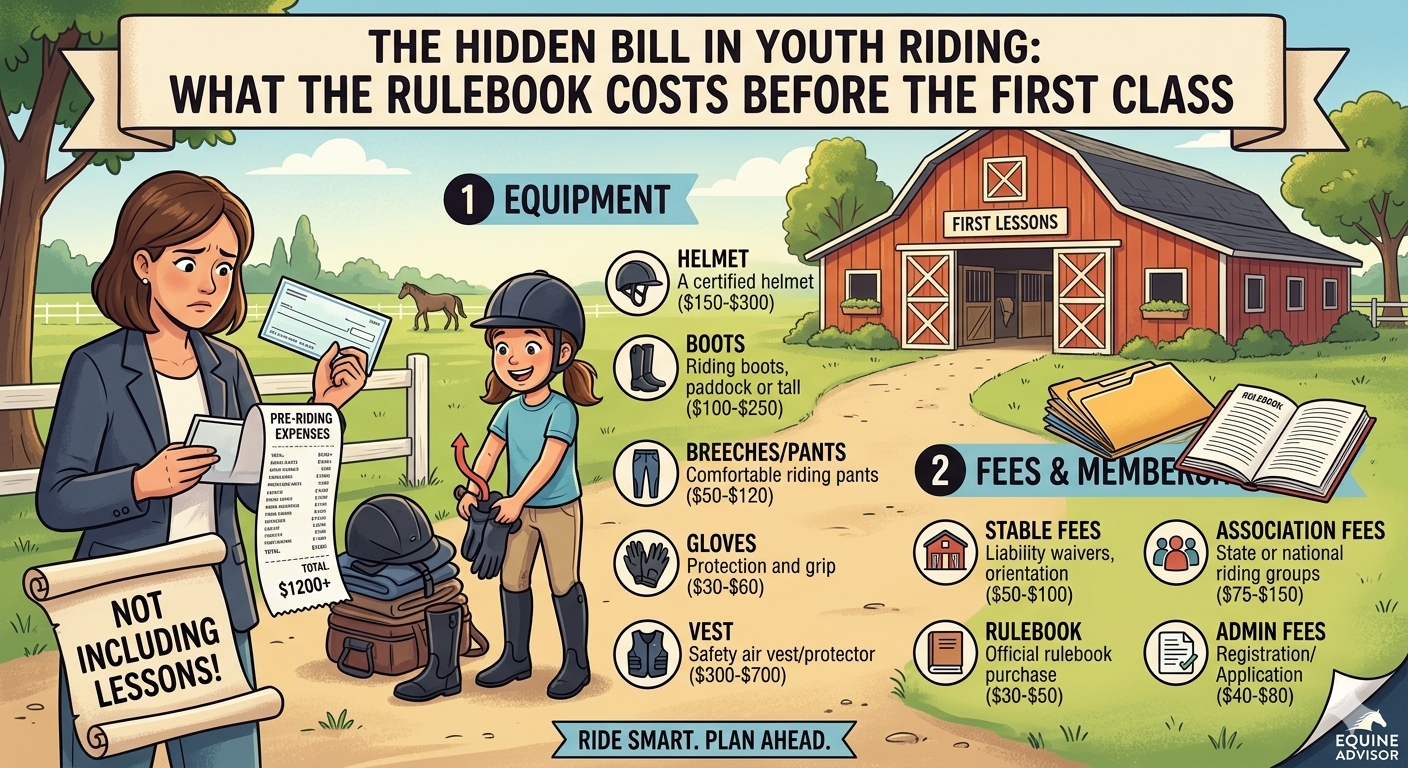
The rulebook is a shopping list
Start with the document that decides what a child wears at a county fair. Iowa's 4-H Rules and Regulations for Equine Shows, published by Iowa State University Extension and Outreach, is unusually specific.
Protective headgear is not negotiable. Every member "must wear properly fitting protective headgear passing or surpassing current applicable ASTM/SEI standards with harness secured while riding anywhere on the competition grounds." The rule closes with six words: "No helmet will result in disqualification."
The rest of the turnout is prescribed almost as tightly. In hunt seat classes riders "must wear hunt coats of traditional colors such as navy, dark green, gray, black, or brown," and the book names maroon and red as improper. Breeches are to be "of traditional shades of buff, khaki, canary, light gray, or rust." Boots are "high English boots or paddock (jodhpurs) boots of black or brown." Hair must be contained. In Western classes, a line that has caught out many first year exhibitors: "Western boots must be worn. (Fashion heels are prohibited.)"
Fail on any of it and the penalty is real but graded: failure to wear appropriate attire "will result in dropping of a ribbon group." Forget the armband and it is a disqualification, same as the helmet.
Read as a uniform, none of this is unusual. Every judged sport has one. Read as an invoice, it is a helmet, a coat, breeches, boots and a shirt before a judge has seen the child ride a single stride.
Two seasons, then a closet
The part that turns a cost into waste is growth. A show coat and a pair of tall boots typically fit a growing child for about two seasons, on garments built to survive a decade of being sat in, rained on and dry cleaned. The gear is not worn out when it leaves. It is outgrown.
Multiply that across every barn in a county and the result is a large quantity of near-new competition clothing sitting in garment bags, while other families buy the same items new.
The economics behind it
Two figures from the American Horse Council explain why this has become more pressing rather than less.
When the Council published its 2023 National Equine Economic Impact Study in January 2024, it valued the industry at 177 billion dollars, up from 122 billion in 2017. Over the same six years, the national horse population fell from 7.2 million to 6.6 million.
More money moving through the sport, fewer horses in it. The difference is cost, and the clothing bill is the part that arrives earliest, before a family has had any of the enjoyment that might justify it.
The apparel market itself is growing steadily. The US equestrian apparel market was estimated at 1.9 billion dollars in 2025 and is forecast to rise from 2 billion in 2026 to 3.4 billion by 2035, a compound annual growth rate of 6.2 percent, according to a December 2025 report from Global Market Insights.
Where families have gone instead
The response has been the same one those families apply to the rest of their wardrobes. ThredUp's 2026 Resale Report, built on analysis by GlobalData, forecasts the US resale market at 78.8 billion dollars by 2030, and found that resale grew roughly four times faster than retail overall last year.
Riding kit is unusually well suited to that trade. It is worn a dozen days a year, built heavily, and sized by conventions that barely shift, which makes buying without trying on far less of a gamble than it is in fashion. What the category lacked was a place to trade that could answer its specific questions: the calf measurement on a boot, the condition of a knee patch, whether a helmet has ever taken a fall.
Four checks, and one hard rule
The episode closes on the practical part, which is worth repeating.
Boots: test the zip, and treat softening at the ankle as a good sign rather than a fault.
Coats: check the shoulders and the underarm lining, where wear shows first, and check the stated colour against the rulebook rather than against a photograph. A coat that looks black on a phone screen and turns out to be navy is legal. Maroon is not.
Breeches: look at the knee patch, because grip goes smooth long before the fabric fails.
Timing: buy in the off season. Tack rooms are cleared between October and February, which is when supply is highest and prices follow.
The hard rule: helmets are bought new, every time. A helmet that has taken an impact can look untouched and protect nothing, because the damage is in the liner. It is also the single item that decides whether a child is allowed to ride at all.
For anyone working out what a first season actually requires, Reequestrian's guide to what riders wear in the hunter ring sets out the rules and the reasons behind each piece.
Why it matters beyond the money
The 4-H horse project is one of the few routes into this sport that does not require a family to own an animal. Iowa State University Extension puts it plainly: "Horse and Pony is an exciting 4-H project area because you can participate whether you own a horse or not."
That openness is undermined quietly, not by entry fees but by a four figure clothing bill that arrives before anything enjoyable has happened. Every coat that moves from one family to another instead of sitting unused keeps a child in the ring who might otherwise have watched from the rail.
Sources: Iowa 4-H Rules and Regulations for Equine Shows, Iowa State University Extension and Outreach; American Horse Council 2023 National Equine Economic Impact Study, released 31 January 2024; Global Market Insights, US Equestrian Apparel Market, December 2025; ThredUp 2026 Resale Report with analysis by GlobalData, as reported by WWD, 2 April 2026.