What Is a CR80 ID Card? Size, Thickness and Printing Explained
0m | Sep 28, 2026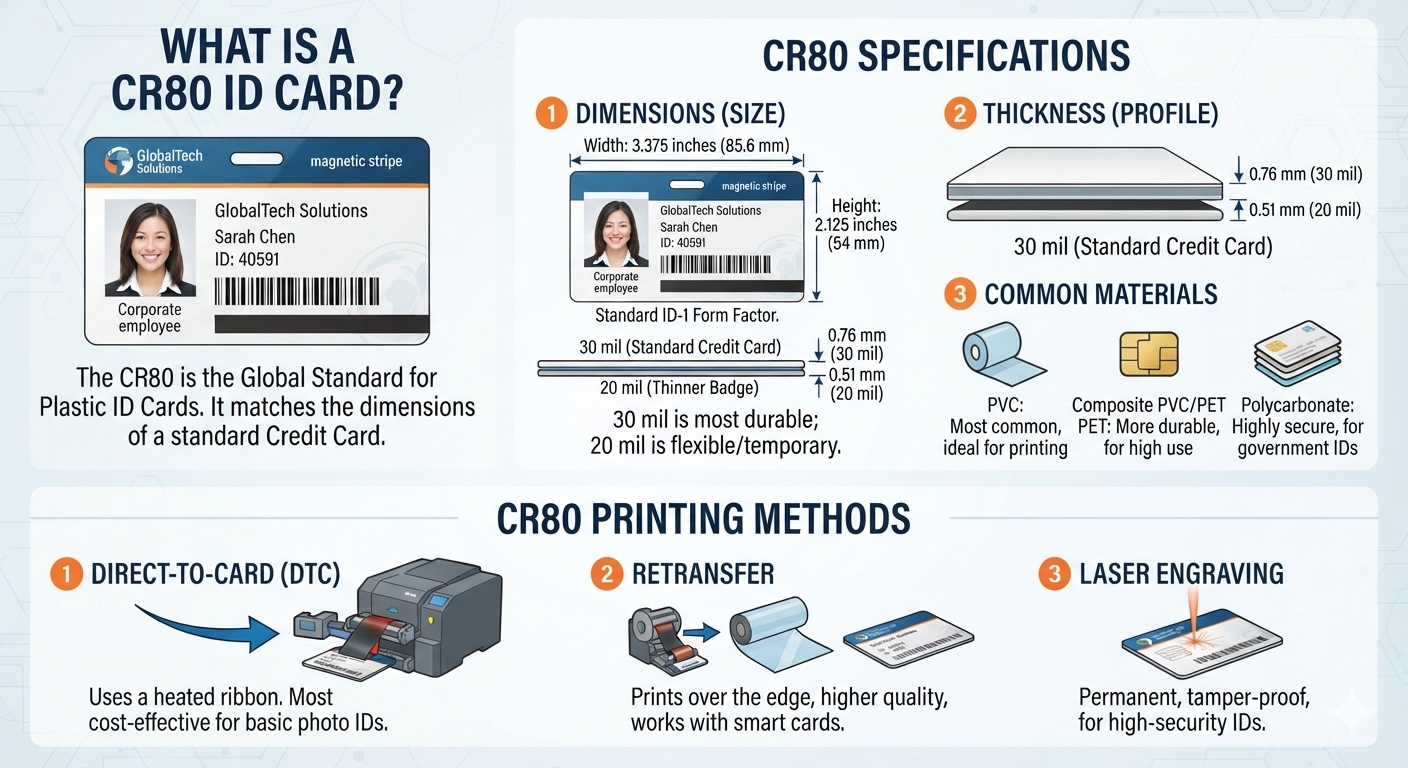
If you have ever ordered employee badges, access cards, membership cards or hotel key cards, you have probably encountered the term CR80. It may sound like a technical specification, but it simply refers to the standard size used for most plastic identification cards.
In fact, there is a good chance you already have several CR80 cards in your wallet. Credit cards, debit cards and many identification cards use essentially the same dimensions.
Understanding CR80 size, card thickness and printing requirements can help businesses avoid ordering the wrong cards, badge holders or printing supplies. Here is what you need to know.
What Is a CR80 ID Card?
A CR80 card is the standard plastic card format commonly used for employee identification badges, access credentials, membership cards and many other types of plastic cards.
The standard CR80 dimensions are approximately:
3.375 inches × 2.125 inches
or
85.60 mm × 53.98 mm
This format corresponds to the ISO/IEC 7810 ID-1 identification-card standard.
One reason CR80 became so widely used is compatibility. The dimensions are familiar to manufacturers of wallets, badge holders, card printers, access-control readers and other equipment.
For organizations ordering professional id cards, CR80 is generally the default format unless there is a specific reason to use a different card size.
Is CR80 the Same Size as a Credit Card?
Yes. For practical purposes, a CR80 ID card has the same dimensions as the standard cards found in most wallets.
That makes CR80 particularly convenient for employee identification. Employees can carry the card in a wallet, attach it to a badge reel or place it inside a standard clear ID holder.
The standardized dimensions also make purchasing accessories easier. Instead of requiring a custom holder for a company badge, businesses can choose from thousands of products designed around the CR80 format.
How Thick Is a CR80 Card?
Card size and card thickness are two separate specifications.
While CR80 describes the width and height of the card, thickness is usually measured in mil. One mil equals one-thousandth of an inch.
A typical CR80 PVC card is:
30 mil thick
That equals approximately:
0.030 inches or 0.76 mm
Thirty-mil cards have the solid, slightly flexible feel most people associate with a credit card.
However, not every CR80 card has to be 30 mil thick. Depending on the application, plastic cards may be manufactured in different thicknesses.
For example, thinner cards may be suitable for temporary credentials, while organizations looking for a more substantial badge may consider 40 mil ID cards.
Before choosing a nonstandard thickness, it is important to verify compatibility with printers, card readers and badge holders.
What Material Are CR80 Cards Made From?
PVC is one of the most common materials used for employee ID cards. It provides a smooth printing surface, reasonable durability and the flexibility expected from a standard identification card.
Composite materials may also be used, particularly when additional durability or resistance to heat is needed.
The card can also contain additional technology without changing its familiar CR80 shape. Depending on the application, a CR80 badge might include a magnetic stripe, RFID technology, NFC functionality or other embedded components.
In other words, CR80 primarily describes the physical card format. It does not determine what information or technology the card can contain.
How Are CR80 ID Cards Printed?
There are several ways to produce CR80 employee ID cards.
Organizations with an ID card printer can print cards internally. Many desktop card printers use dye-sublimation technology to transfer photographs, logos, text and other graphics onto plastic cards.
Businesses can also use professional online ID card printing services instead of purchasing and maintaining their own printer. This can be especially practical when cards are ordered periodically rather than printed continuously throughout the day.
Regardless of the printing method, artwork should be created with the final CR80 dimensions in mind.
A card can be designed horizontally at approximately 3.375 × 2.125 inches or vertically at 2.125 × 3.375 inches. Portrait and landscape cards are physically the same size—the orientation simply changes.
What Resolution Should CR80 Artwork Use?
Resolution matters when creating photographs, logos and background graphics for an ID card.
At 300 DPI, the physical dimensions of a CR80 card translate to roughly 1,012 × 638 pixels, depending on the exact dimensions and rounding used by the design or printing system.
Printing providers may request slightly larger artwork when bleed is required. Bleed extends the background beyond the final cut or printable boundary so that small production variations do not leave an unwanted white edge.
Important information should also stay away from the outer edge. Names, employee numbers, photographs, QR codes and other essential elements should be positioned within a safe area.
CR80 vs. Other ID Card Sizes
Although CR80 is the standard, other card formats exist.
CR79 cards are slightly smaller and are sometimes used with adhesive-backed applications or certain proximity-card systems.
CR100 cards are considerably larger than CR80 and can be useful when identification needs to be visible from farther away, such as at conferences, events or secure facilities.
For most everyday employee identification applications, however, CR80 remains the most practical choice.
Why CR80 Is the Standard for Employee ID Cards
Standardization makes ID programs easier to manage.
Using CR80 cards means organizations can easily find compatible badge holders, lanyards, reels, printers and other accessories. Employees are also familiar with the size because it feels exactly like the cards they already carry every day.
A standard 30 mil CR80 PVC card is therefore a good starting point for most employee identification programs. From there, businesses can customize the card with photographs, job titles, company branding, QR codes, barcodes, magnetic stripes or contactless technology.
The important thing to remember is simple: CR80 describes the standard credit-card-sized format, while specifications such as 30 mil or 40 mil describe thickness.
Once those two measurements are understood, choosing the right employee ID card becomes much easier.