Turnkey PCB Assembly vs. Partial Turnkey: Which Is Better for Your Project?
1m | Sep 17, 2026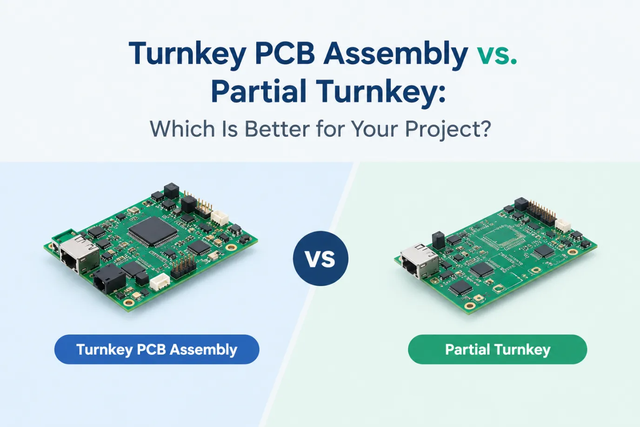
Choosing the right PCB assembly model can make a major difference in your project’s cost, timeline, and overall production experience. Whether you are building a prototype, preparing for pilot production, or scaling into full manufacturing, one important decision is whether to use turnkey PCB assembly or partial turnkey assembly.
Both options can work well, but they serve different needs. Understanding how they differ will help you choose the approach that best matches your budget, schedule, sourcing capabilities, and quality requirements.
What Is Turnkey PCB Assembly?
Turnkey PCB assembly is a complete manufacturing solution where the PCB assembly provider manages nearly every step of the process. This usually includes PCB fabrication, component sourcing, assembly, inspection, testing, and final delivery.
Instead of coordinating with multiple suppliers, customers can send their design files, bill of materials, and production requirements to one manufacturer. The manufacturer then takes responsibility for turning the design into finished assembled boards.
For companies that want to save time and reduce supply chain complexity, Turnkey PCB Assembly Services can be an efficient and practical choice.
What Is Partial Turnkey PCB Assembly?
Partial turnkey PCB assembly is a more flexible model. In this arrangement, the customer provides some of the components, while the assembly provider supplies the rest and handles manufacturing.
For example, a customer may already have certain critical ICs, connectors, sensors, or custom parts in stock. They can ship those parts to the assembler, while the manufacturer sources common resistors, capacitors, PCBs, and other standard materials.
This approach gives customers more control over specific components while still allowing them to outsource much of the assembly process.
Key Differences Between Turnkey and Partial Turnkey
The main difference lies in responsibility.
With turnkey assembly, the manufacturer handles the full production workflow. With partial turnkey assembly, responsibility is shared between the customer and the assembler.
Turnkey assembly is often simpler from a project management perspective. It reduces the need to communicate with multiple vendors, track component shipments, or manage inventory. Partial turnkey assembly, however, may be better when the customer already owns expensive, specialized, or hard-to-source parts.
Another key difference is sourcing control. Turnkey assembly relies heavily on the manufacturer’s supply chain. Partial turnkey allows the customer to decide where certain components come from, which may be important for regulated industries, legacy products, or designs using proprietary parts.
Advantages of Turnkey PCB Assembly
The biggest advantage of turnkey PCB assembly is convenience. One supplier manages the entire process, which reduces communication overhead and helps prevent delays caused by coordination problems.
Turnkey assembly can also shorten production time. Since the manufacturer handles sourcing and assembly together, they can often plan procurement and production more efficiently. This is especially useful for startups, engineering teams, and companies that need prototypes or small batches quickly.
Quality control can also be easier to manage. When one supplier is responsible for fabrication, sourcing, assembly, and testing, it is easier to trace issues and correct them. There is less finger-pointing between vendors if a problem occurs.
Turnkey assembly is also helpful for teams without strong purchasing experience. Component sourcing can be complicated, especially when dealing with shortages, substitutions, counterfeit risks, and minimum order quantities. A capable assembly partner can help reduce these risks.
Advantages of Partial Turnkey PCB Assembly
Partial turnkey assembly offers more control. If your project uses sensitive, expensive, or custom components, you may prefer to purchase and provide those parts yourself.
This model can also be cost-effective when you already have inventory. Instead of buying duplicate components through the manufacturer, you can use existing stock and reduce waste.
Partial turnkey assembly is also useful when certain components require strict approval or traceability. In medical, aerospace, automotive, or industrial applications, companies may need to maintain control over approved suppliers and component documentation.
It can also be a good option for mature products. If your company has an established supply chain but wants to outsource the assembly work, partial turnkey provides a balanced solution.
Which Option Is Better for Prototyping?
For most prototypes, turnkey assembly is often the better choice. Speed and simplicity are usually more important during early development. Engineers want to test designs quickly, find issues, and move to the next revision without spending too much time on procurement.
Turnkey assembly allows teams to focus on design validation instead of supply chain management. It also reduces the risk of delays caused by missing components or mismatched ordering schedules.
However, partial turnkey may be better if the prototype uses special parts that are difficult to replace or already available in-house.
Which Option Is Better for Production?
For low- to medium-volume production, turnkey assembly can still be highly effective. It keeps the process streamlined and may reduce administrative costs.
For larger production runs, the better choice depends on your sourcing strategy. If your manufacturer offers reliable pricing, traceability, and quality control, full turnkey can be an excellent long-term solution. If your company has negotiated component pricing or must use approved suppliers, partial turnkey may provide better control.
In many cases, businesses use both models at different stages. They may choose turnkey assembly for prototypes and early runs, then move to partial turnkey or customized sourcing for mass production.
Factors to Consider Before Choosing
Before deciding between turnkey and partial turnkey PCB assembly, consider these questions:
- Do you already have key components in stock?
- Are any components custom, rare, or difficult to source?
- How quickly do you need the finished boards?
- How much control do you need over suppliers?
- Does your project require strict traceability?
- Do you have internal purchasing and inventory management resources?
- Is your priority speed, cost control, flexibility, or simplicity?
If your goal is to reduce workload and launch quickly, turnkey assembly is usually the stronger choice. If your goal is to control specific parts and sourcing decisions, partial turnkey may be more suitable.
Why the Right Assembly Partner Matters
No matter which model you choose, the assembly partner plays a major role in project success. A reliable manufacturer should be able to review your design files, check your BOM, identify sourcing risks, suggest alternatives when needed, and maintain clear communication throughout production.
Working with an experienced provider such as OrinewPCB can help simplify the process from PCB fabrication to final assembly. The right partner can support both turnkey and partial turnkey models, making it easier to choose the best fit for each project stage.
Final Thoughts
Turnkey PCB assembly and partial turnkey assembly are both valuable options. Turnkey assembly is best for teams that want a fast, simple, and fully managed production process. Partial turnkey assembly is better for companies that need more control over selected components or already have parts available.
For prototypes, startups, and projects with tight deadlines, turnkey assembly often provides the greatest efficiency. For complex products, regulated industries, or established supply chains, partial turnkey may offer the right balance of control and support.
The best choice depends on your project’s priorities. By understanding the differences and working with a capable PCB assembly partner, you can reduce risk, improve production efficiency, and bring your electronic products to market with greater confidence.